
Intro
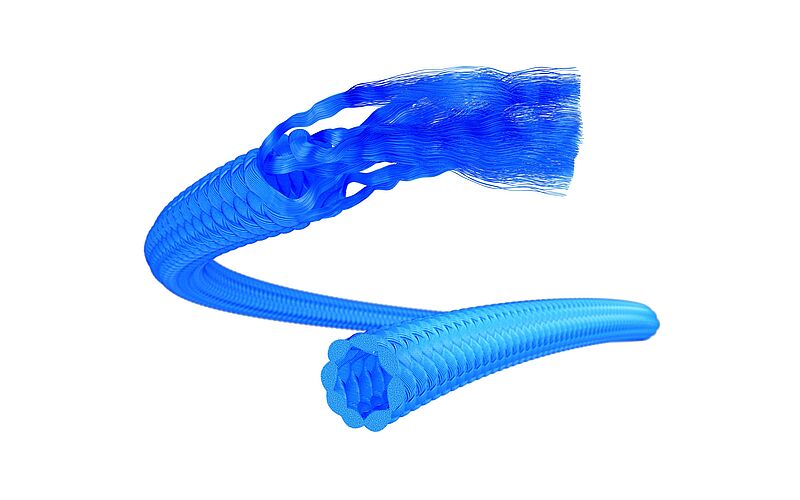
To produce a braided continuous filament, 12 to 16 filament yarns (continuous filament bundles) – depending on the thickness of the finished thread – are wound together on so-called clappers in a circular weaving process. This means that the production time for a ‘braided thread’ is significantly longer (18 times longer than the production of a comparable continuous filament yarn).
The most commonly used raw material for braided continuous filaments is polyester. Due to their construction and the continuous filaments used, braided threads have a smooth and decorative surface. Their tear resistance and abrasion resistance are very good.
Braided threads are used for decorative seams on shoes, upholstery and leather. Their special construction really shows off the seam to its best advantage.
AMANN's braided polyester continuous filament is Serabraid. Unlike all other sewing threads and embroidery threads, the ticket numbers are based on the optical diameter. Serabraid 800 has an optical diameter of 0.8 mm, etc.
Serabraid is available in three different finishes:
- T60 suitable for machine sewing
- T90 (waxed) for hand sewing
WRe (water-repellent, eco-friendly) suitable for machine sewing

FAQ
-
A braided continuous filament thread is made by intertwining 12 to 16 continuous filament bundles in a circular weaving process, forming a decorative and robust thread construction.
-
Multiple filament bundles are wound together on special carriers (“clappers”) in a circular braiding process. This production method is significantly more time-consuming than standard filament yarn production.
-
The circular braiding process is considerably more complex than conventional twisting. Production time can be many times longer compared to comparable continuous filament yarns.
-
Polyester is the most commonly used raw material for braided continuous filament sewing threads.
-
Braided threads offer very good tear resistance and abrasion resistance, along with a smooth and decorative surface.
-
The braided construction creates a visually prominent and structured surface that enhances the appearance of seams.
-
Typical applications include decorative seams on shoes, leather goods, upholstery and other visible seam areas.
-
Unlike most sewing threads, braided threads are often classified by optical diameter. For example, a designation such as 800 refers to an optical diameter of 0.8 mm.
-
Yes. Depending on the finish, braided threads can be suitable for machine sewing, hand sewing or water-repellent applications.
-
Typical finishes include versions for machine sewing, waxed versions for hand sewing and water-repellent finishes.