
Intro
The series of portraits I produced for AMANN Group was something new for me.
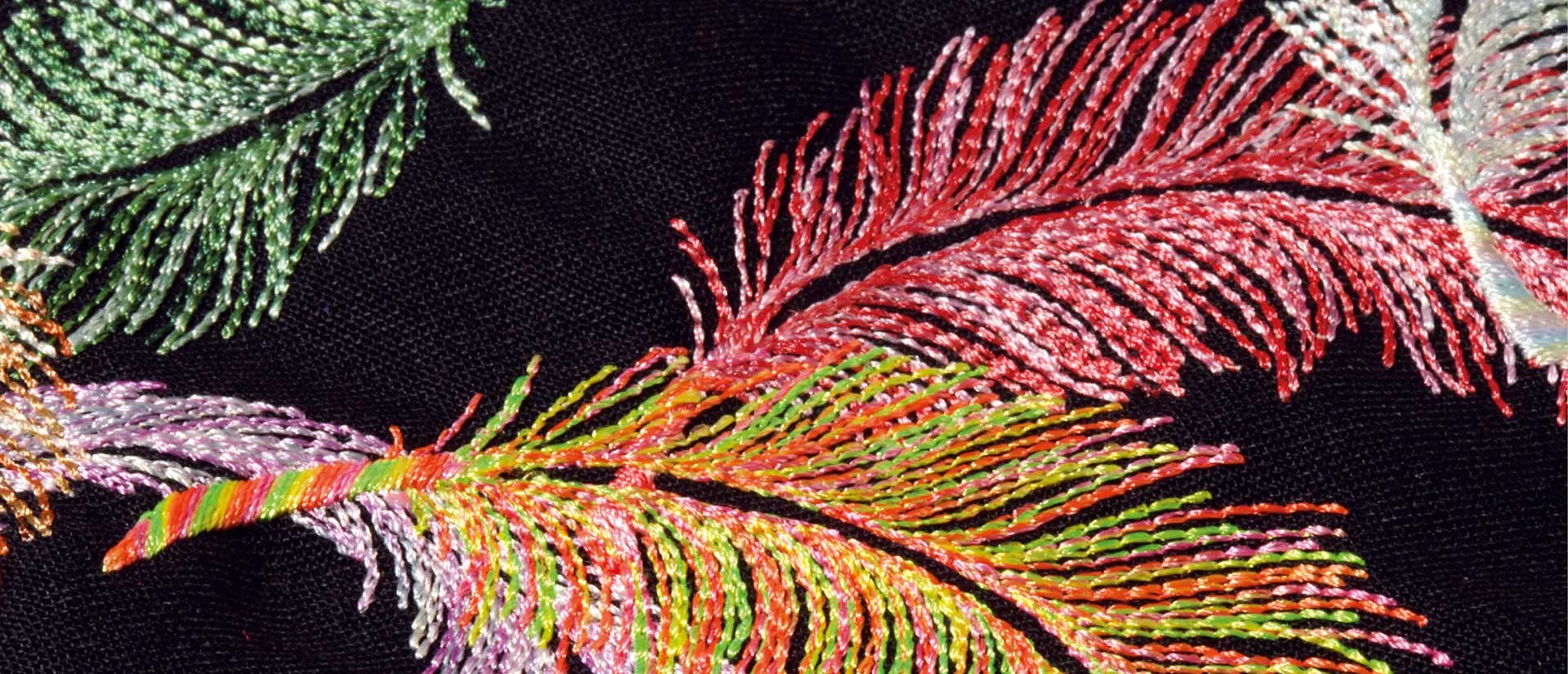
My personal embroidery style has evolved over 40 years. Even though it may be recognizable to some in the industry, I am constantly changing and experimenting - especially with stitch types and their subtle variations.
My work is deeply influenced by years of landscape painting. Painting taught me to understand lighting, depth, colour interaction and form. To bring a scene to life on canvas, you must know how colours influence each other, how they blend and how different brush strokes create structure and movement. Details are then added to ground the image and guide the focus.
Over time, I began transferring this painting knowledge to digitizing.
The difference from standard embroidery lies in how stitch types are combined and how stitch parameters and stitch distance are adjusted.
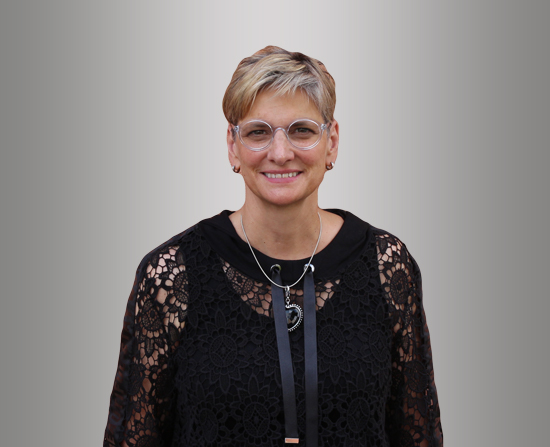
Bonnie Nielsen
Technical Advisory Services, AMANN Group
More than 40 years of experience as embroidery expert
Author of “Punch Digitizing for Embroidery Design”
Four main principles that define Bonnie's work
There are 4 main guiding principles that define my work.
Principle 1: Let the design breathe
I like my designs to breathe.
In many cases, the fabric structure and colour are not just backgrounds - they are part of the final result. I deliberately leave open spaces between stitch types or increase the stitch distance to allow the fabric colour to peek through.
This openness creates interaction between thread and textile. The embroidery does not dominate the surface; it becomes part of it.
The result feels lighter, more natural - and often more expressive.
Principle 2: Movement and texture
Movement begins with stitch direction.
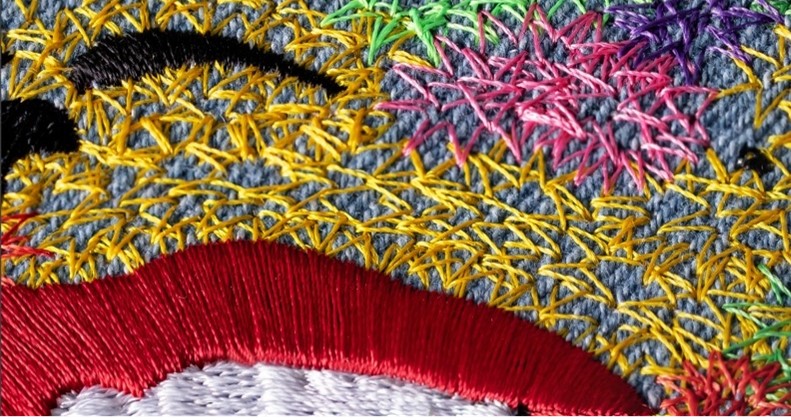
For larger forms, I use curved stitch direction lines instead of straight ones. Alternating stitch directions not only create flow but also influence depth. Crossing stitch directions builds texture.
Stitch length is another powerful tool. By varying stitch lengths - making some longer and others shorter - texture and surface character emerge.
One way to expand experimentation is by using different thread sizes or even multiple thread sizes within one design.
When working with thick threads, it is important to understand that they are highly prominent on the surface. Every stitch has a strong visual impact.
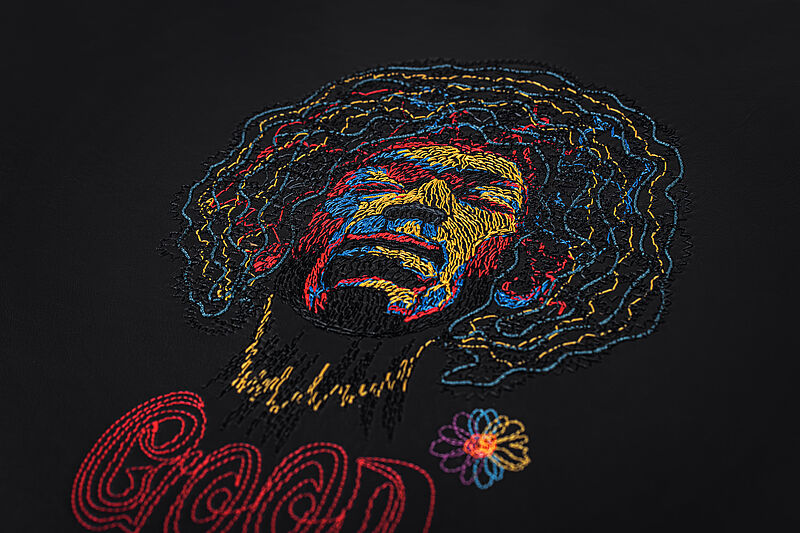
In the Jimmy Hendrix sample, AMANN Serafil ticket 20 (tex #135) was used. The facial features were created manually - no automatic program placed these stitches. Each stitch was positioned individually, with different lengths and placements, to create texture and expression.
A design using such thick thread can only be produced on a special embroidery machine capable of handling larger ticket sizes, with different hook and tension settings than standard machines.
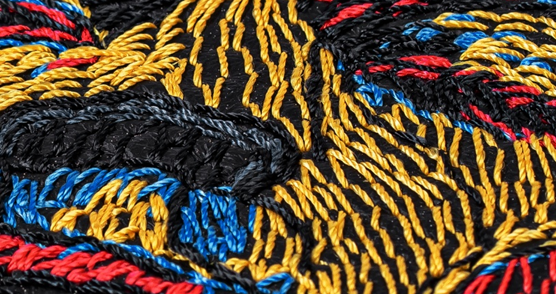
Additional embroidery attachments can further enhance movement. For Jimmy’s hair, braided AMANN Serabraid was used. By stitching over the cord afterwards with Serafil ticket 20, the cord was integrated into the design without covering it completely.

At the base of the design, AMANN's Isacord was used to create a finer and more controlled look for “GOOD VIBES” and the flowers.
The interplay of thick and fine threads creates contrast and liveliness.

Principle 3: Colour blending or pixelation
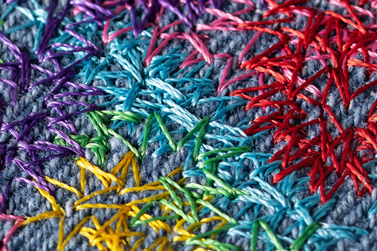
Colour blending techniques are achieved by opening up the stitch distance so the fill is no longer solid.
To blend colours, the same stitch direction is used when layering colours on top of one another. This allows the stitches to fall into each other, creating smooth transitions.
Throughout the design, different stitch distance settings were used depending on the desired effect.
For a pixelated look, stitches must cross each other. When different colours intersect at varying directions, a fragmented surface appears — producing the pixelated effect.
Both techniques rely on controlling stitch direction and stitch distance with precision.

Principle 4: Defamiliarizing stitch types
Another principle in my work is rendering stitch types in an unfamiliar way.
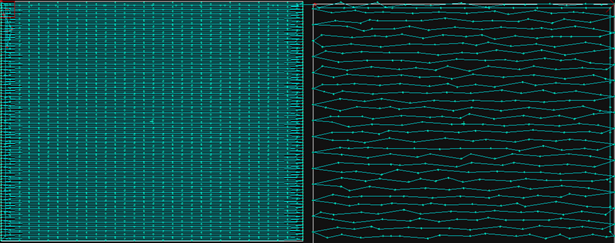
By entering non-standard values into stitch type parameters, fill stitches can appear entirely different from their default settings. The possibilities depend on the digitizing software and the level being used.
The display of stitches inside the digitizing software becomes an experimental space.
Standard settings are still used in parts of the design to ground it and create recognizable forms. But by overlapping different stitch types and colours - and pushing parameters beyond standard values - new visual expressions emerge.
All designs were digitized using EPC software from ZSK.
Impressionistic embroidery
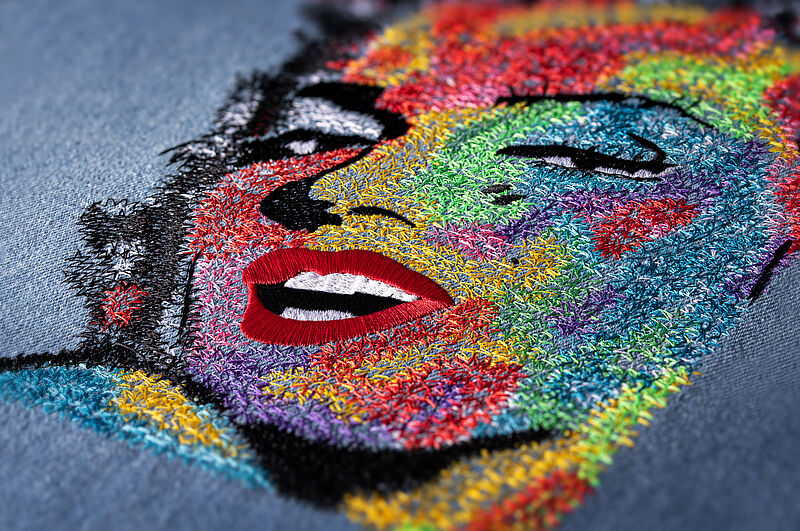
The style I have developed over the years is a combination of these four principles, interacting with overlapping stitch types and colours.
Up close, the embroidery may look almost chaotic - textures crossing, directions shifting, stitch lengths varying.
But step back.
From a distance, the image comes together. Light, depth and form become visible. The portrait reveals itself.
That is why I describe my work as impressionistic.
The magic happens at a distance.
FAQ
-
Impressionistic embroidery is a style where stitch direction, stitch distance and thread variation are used to create depth, light and movement that become visible from a distance.
-
From a distance, colours, stitch directions and textures visually blend together, revealing the intended image.
-
It means intentionally leaving space between stitches so the fabric colour becomes part of the design.
-
Stitch direction controls light reflection, depth perception and movement within the design.
-
Varying stitch lengths creates surface texture and visual dynamism.
-
Colour blending is achieved by layering stitches in the same direction with increased stitch distance to create smooth transitions.
-
A pixelated look occurs when stitches in different directions intersect and colours cross each other.
-
Combining thick and fine threads creates contrast, depth and emphasis.
-
No. Larger ticket sizes require machines with adapted hook and tension settings.
-
It means modifying standard stitch parameters to create new visual effects beyond default settings.
-
Digitizing controls stitch type, density, direction and layering, which define the final visual outcome.
-
Fabric structure and colour can interact with open stitch areas, influencing the overall aesthetic.