
Intro
Beautiful seams do not happen by chance, but are the result of correctly selected sewing parameters. In order to sew a beautiful seam with correct thread balance, it is essential to select the appropriate sewing needle size. There are technological factors that should be taken into account when selecting the needle size.
The needle
The components of the needle, which must match the thickness of the sewing thread, are:
- the eye of the needle (the thread must fit through the eye of the needle)
- the long groove (the thread must fit into the long groove, as this protects it during the repetitive movement through the fabric)
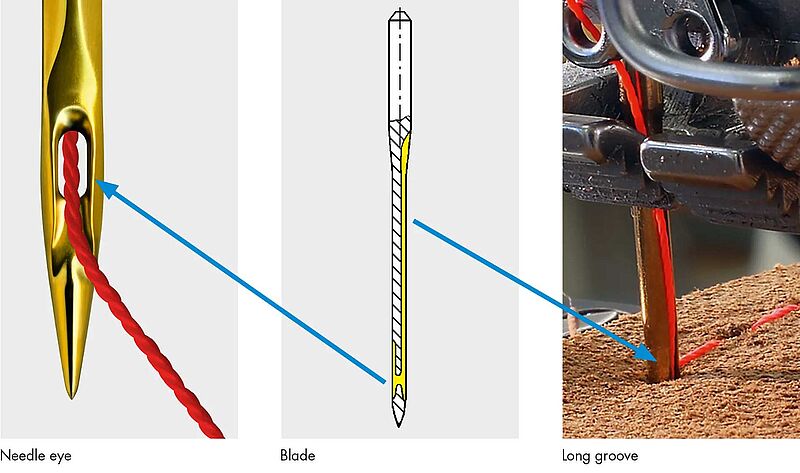
In Europe, needle sizes are given in Nm, which indicates the diameter of the needle in hundredths of a millimeter. This means that a needle with size Nm 100 has a blade diameter of 1 mm.
Impact on sewing performance
The diameter of the eye/long groove of standard sewing needles is approx. 40% of the blade diameter. The sewing thread must therefore be thinner than 40% of the sewing needle diameter in order to avoid damage during its movement through the eye and the fabric. This ensures high sewing performance.
Influence on stitch formation and thread tension setting
In addition to sewing performance, the stitch formation and thread tension setting are also influenced by the needle size. The needle creates space in the fabric for the stitch interlock, especially in the case of hard materials such as leather, dense fabrics, fine-mesh knitted and crocheted fabrics or materials with surface finishes (e.g. printed surfaces). Unfortunately, due to their nature, these materials are often highly susceptible to damage (e.g. fabric damage, material damage) caused by the needle puncture. To avoid such damage or keep it to a minimum, the smallest possible needles must be used. However, these must be compatible with the planned sewing thread sizes.
What happens if a very fine needle is chosen to avoid damaging the material and the intended sewing thread is therefore no longer suitable for the needle size?
Example
Outer fabric: close-knit knitwear
Stitch type: double lockstitch (stitch type 301)
Sewing thread: Saba 80 (thread diameter: approx. 0.26 mm)
Suitable needle size: Nm 90–100/Size 14–16
Needle size used: Nm 70/Size 10 (diameter of needle at blade: 0.7 mm)
| Nm 80 (size 12) SES | Nm 70 (size 10) SES | |
|---|---|---|
| Material damage in lateral view of the seam | 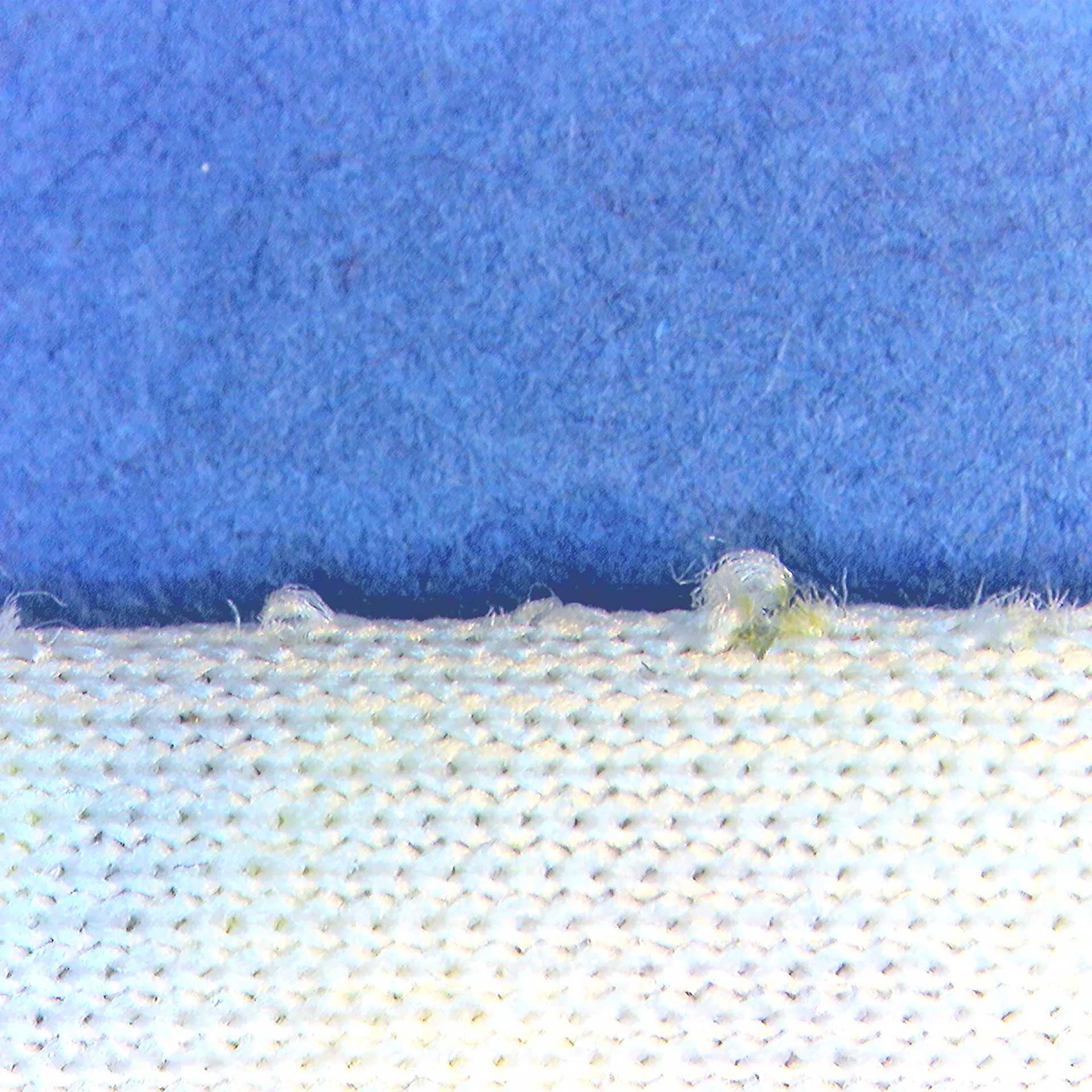 | 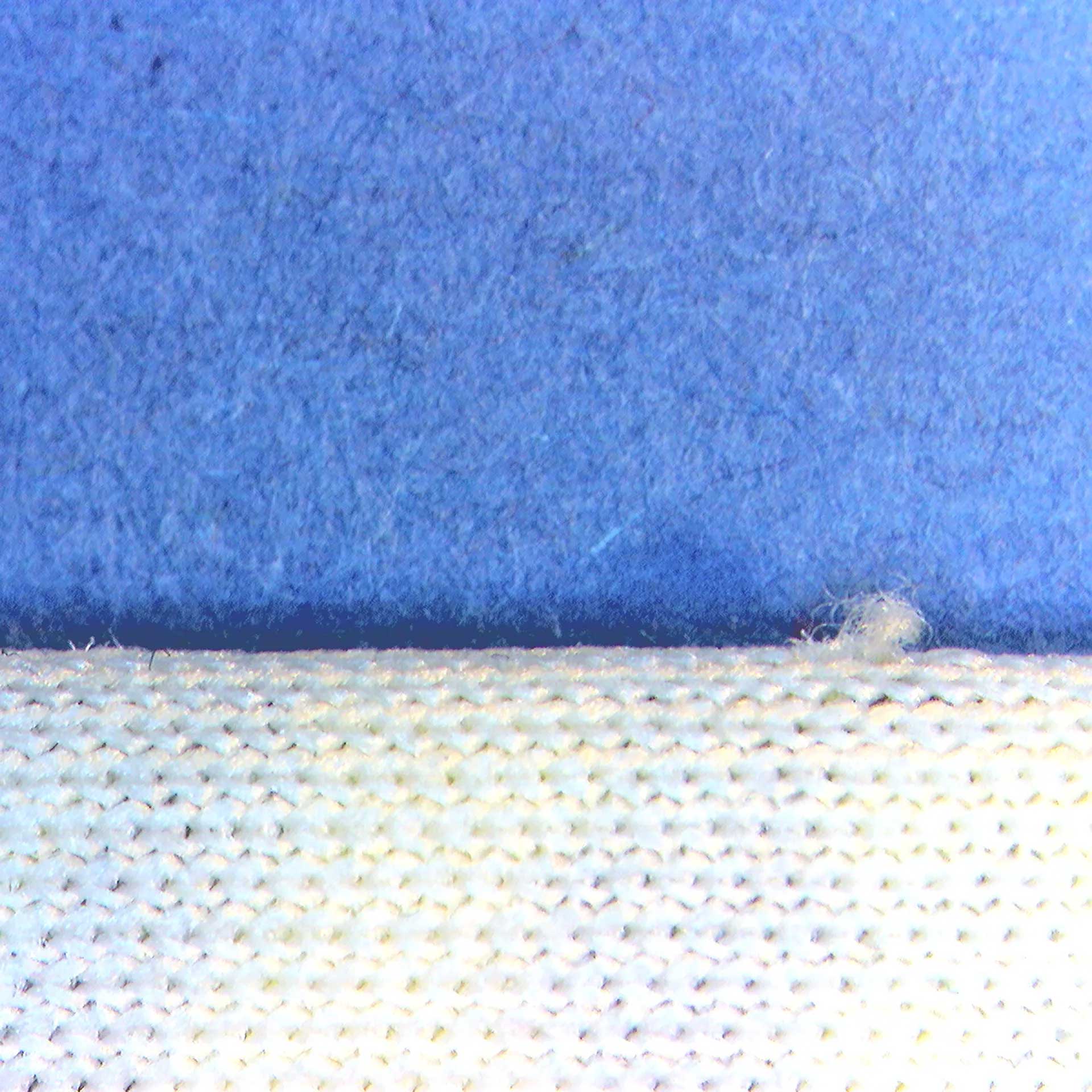 |
| Upper view of the seam | 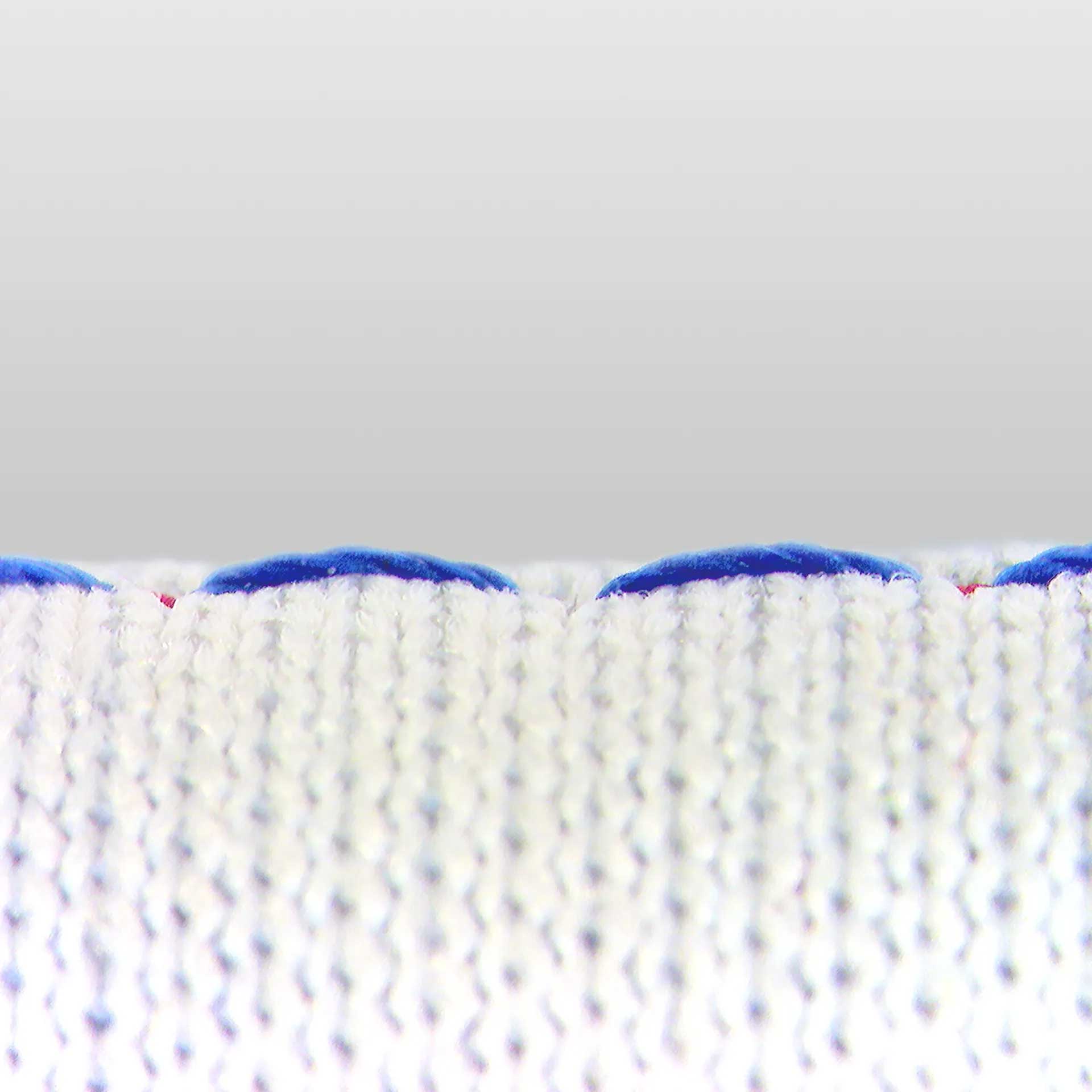 | 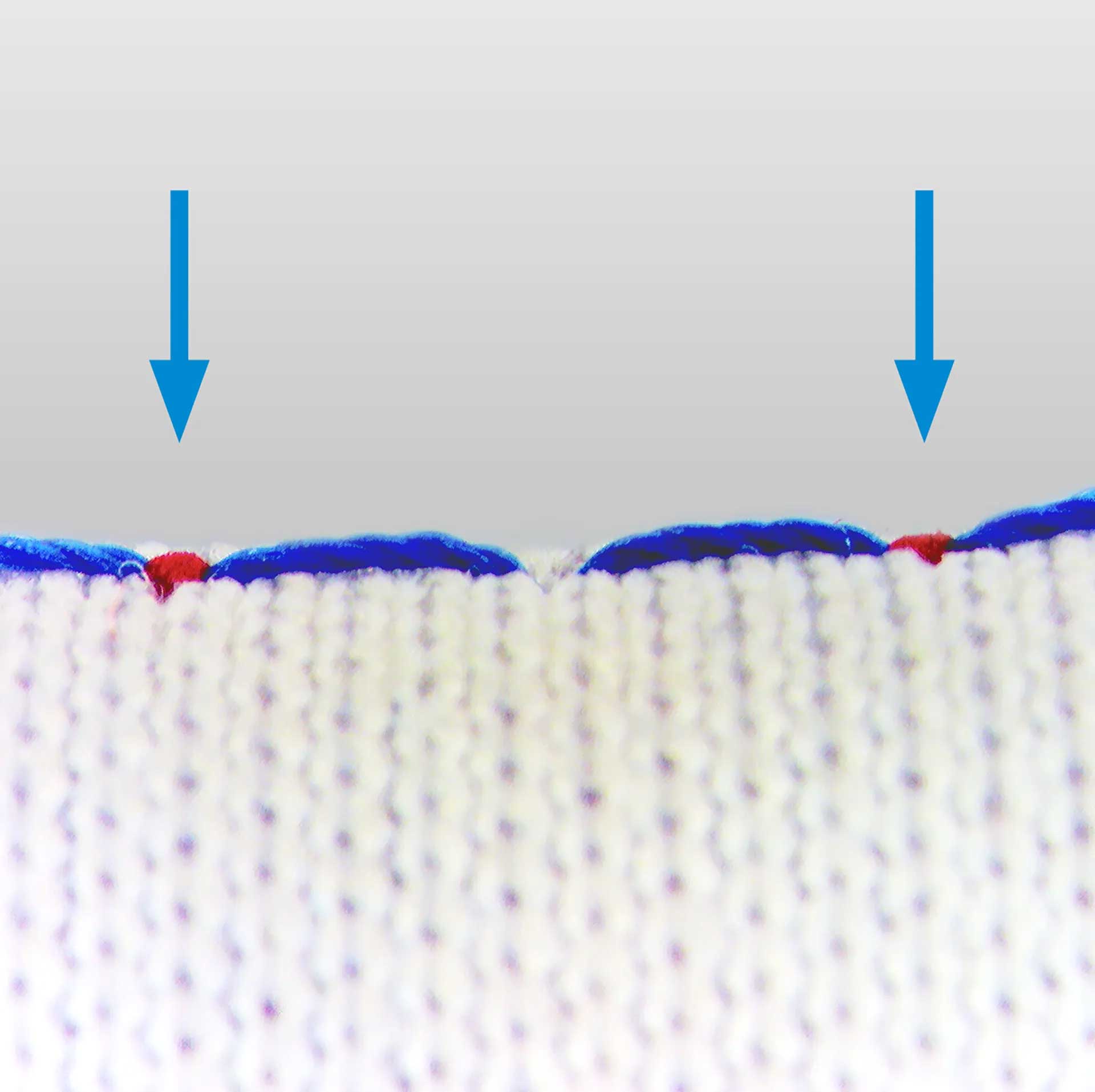 |
| Bottom view of the seam | 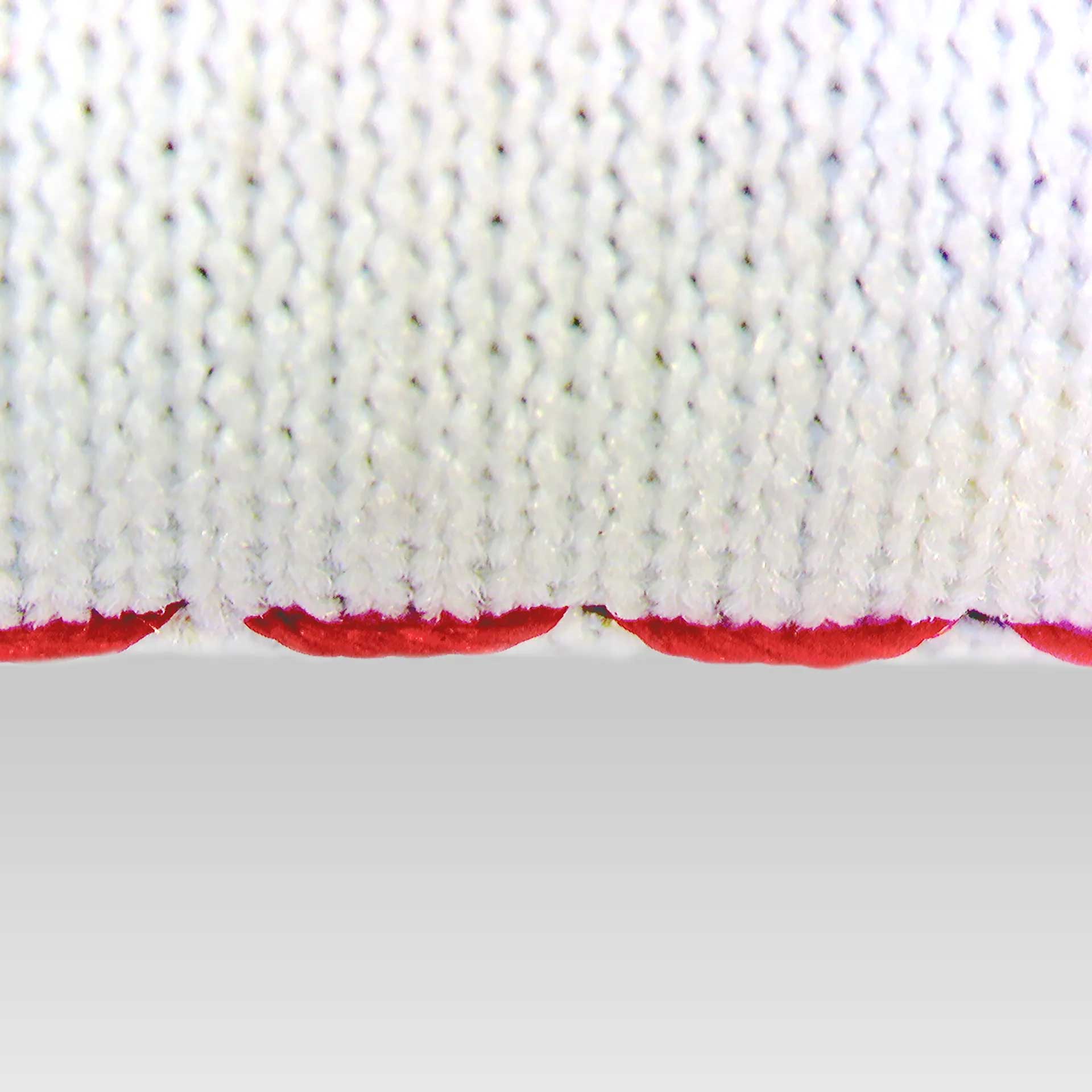 | 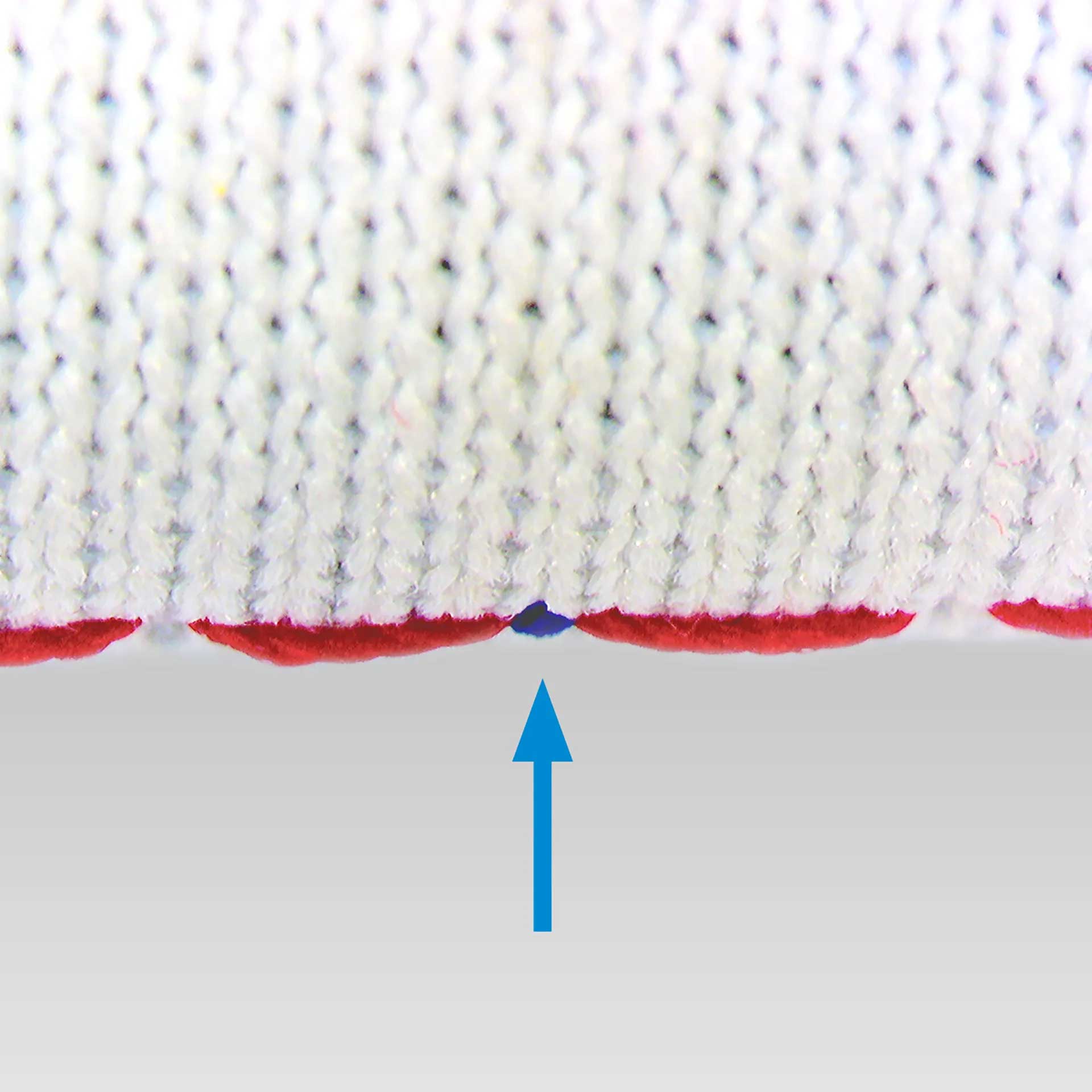 |
Explanation
Dense materials have a very low yield in the stitch hole area and therefore create little space for the thread knot in the fabric.
The needle creates only a small stitch hole with a diameter of 0.7 mm.
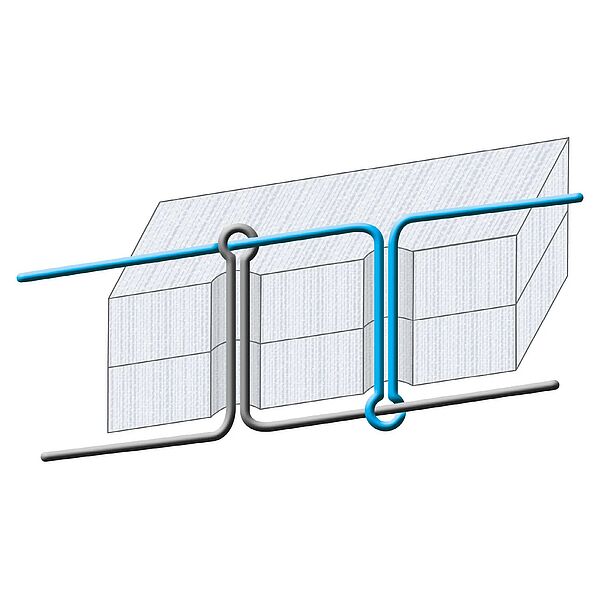
The stitch interlocking of needle and bobbin thread in the double lockstitch means: sewing thread diameter × 4, i.e. stitch interlocking diameter of 1.04 mm.

The stitch interlocking is therefore thicker (1.04 mm) than the diameter of the stitch hole (0.7 mm).

Stitch interlocking diameter 1.04 mm – due to the sewing thread diameter of 0.26 mm
Stitch interlocking with double lockstitch (stitch type 301)
The following results from the previous points:
- Very high thread tension is required to pull the stitch interlocking into the needle's small stitch hole.
- This results in an irregular stitch formation/thread tension, as the knot either gets caught on the underside of the fabric or slips through to the top of the fabric due to the high thread tension. It is almost impossible to place the knot in the centre of the fabric.
- The seam may pucker due to the high thread tension.
- In extreme cases, thread breaks and/or skipped stitches may occur.
- The uneven stitch feed can have a negative effect on the elasticity and strength of the seam.
Summary
When using needle size Nm 80, stitch breakage occurs with almost every stitch. However, the stitch formation is even and the stitch interlocking is located in the centre of the outer fabric. Using the finer needle size Nm 70 significantly reduces damage. However, the stitch formation is uneven because the stitch hole of the 70 needle is not large enough and the knots are sometimes on the top and sometimes on the bottom of the upper fabric. Centred stitch interlocking is only possible with increased thread tension, but this is difficult to achieve in practice.
If coarse sewing thread must be used, there is no solution to this problem for very difficult or delicate materials. You then have the choice between:
Small needle and no damage – but uneven stitch pattern!
OR
Larger needle and material damage – but uniform stitch pattern!
Only by selecting a finer sewing thread material damage can be avoided and an even stitch pattern achieved.
Conclusion
It is advisable to test the outer fabrics for material damage well in advance of the start of production. For example, you can sew over two layers of the outer fabric using different needle sizes and then examine the needle punctures for damage using a magnifying glass. Once you have determined which needle size can be used without causing damage, you should select the sewing thread that is suitable for that needle size. As already explained in detail, coarser sewing threads are not suitable for use with needles that are too fine.
FAQ
-
The correct sewing needle size must match the thickness of the sewing thread and the material. The thread must fit through the needle eye and into the long groove without damage. Proper selection ensures stable sewing performance and consistent stitch formation.
-
Needle size directly influences stitch formation and thread tension. If the needle is too small, the stitch interlocking cannot be positioned correctly in the fabric. This leads to irregular stitches, seam puckering, and reduced seam quality.
-
If the needle is too fine, the stitch hole becomes too small for the thread interlocking. This requires very high thread tension and results in uneven stitch formation. In extreme cases, thread breakage and skipped stitches can occur.
-
Yes, larger needles can cause visible material damage, especially in delicate or dense fabrics. Needle punctures may weaken the material or damage surface finishes. Therefore, the smallest possible compatible needle size should be used.
-
Smaller needles require higher thread tension to pull the stitch interlocking into the stitch hole. This makes it difficult to achieve a balanced seam. Larger needles allow easier thread movement but may increase the risk of fabric damage.
-
The needle creates the stitch hole, while the thread forms the stitch interlocking. If the interlocking diameter is larger than the stitch hole, the seam becomes unstable. This imbalance leads to irregular thread positioning and reduced seam performance.
-
Yes, there is often a trade-off between avoiding material damage and achieving a uniform stitch pattern. Smaller needles protect the fabric but can cause irregular stitches. Larger needles improve stitch formation but may damage the material.
-
Outer fabrics should be tested in advance using different needle sizes. Sewing trials on multiple fabric layers and inspecting needle punctures help identify damage risks. Based on this, the suitable sewing thread and needle combination can be selected.