
Intro
Water-permeable seams are a common problem that usually only becomes apparent when moisture has penetrated through the seams into the inside of the garment. After such an experience, it is questionable whether you will trust the same garment again the next time it rains.
There are five main factors that determine seam impermeability:
- Sewing thread
- Needle
- Material
- Stitch type
- Seam construction
Factor 1: The sewing thread
The choice of sewing thread is crucial for the seam's waterproofness. When wet, normal sewing threads (i.e. without special water-repellent treatment) absorb moisture on the thread surface and transfer it inwards (e.g. into a tent or shoe). This is called the capillary or wicking effect.
Conventional sewing threads therefore do not meet the criteria for water repellency. This requires sewing threads with a special water-repellent finish. This delays the wicking effect and thus also the transport of moisture. AMANN products with a water-repellent finish can be found under the designation ‘WRe = water-repellent, eco-friendly’.
The aforementioned wick or capillary effect can be visualised using a simple experimental setup. This involves comparing the behaviour of ‘normal’ and water-repellent sewing threads when they come into contact with ink/water.

Sewing thread with water-repellent finish
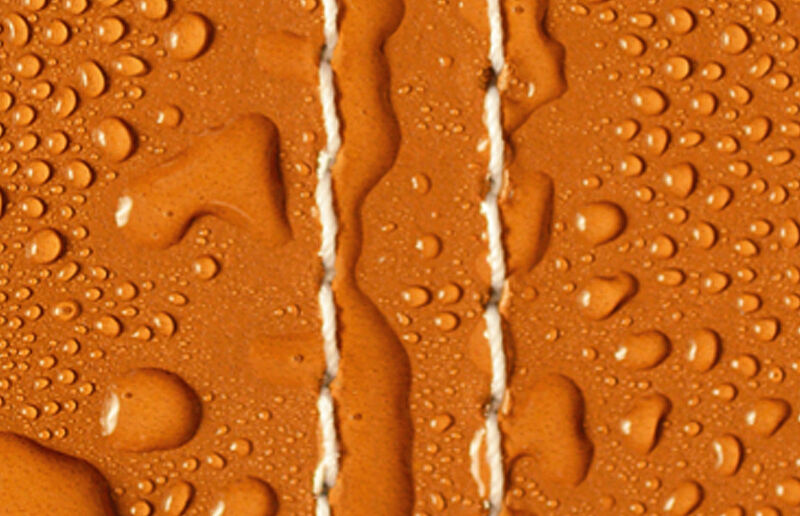
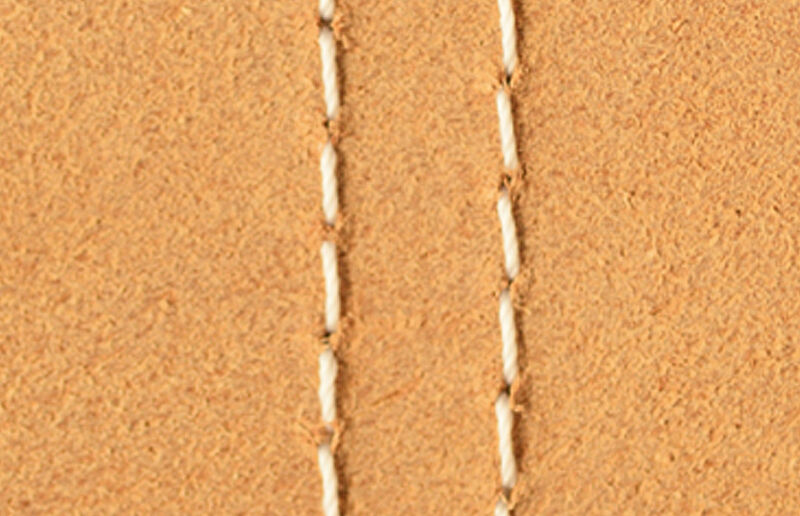
- No capillary effect
- The thread does not absorb water
Sewing thread without water-repellent finish
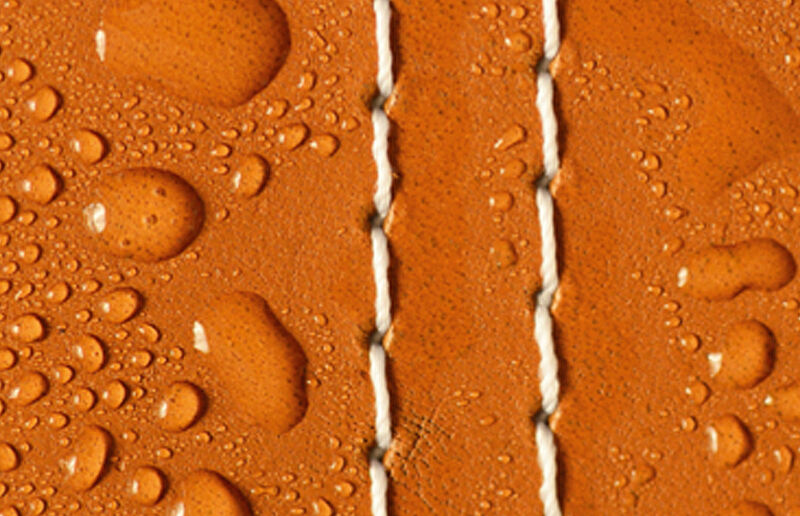
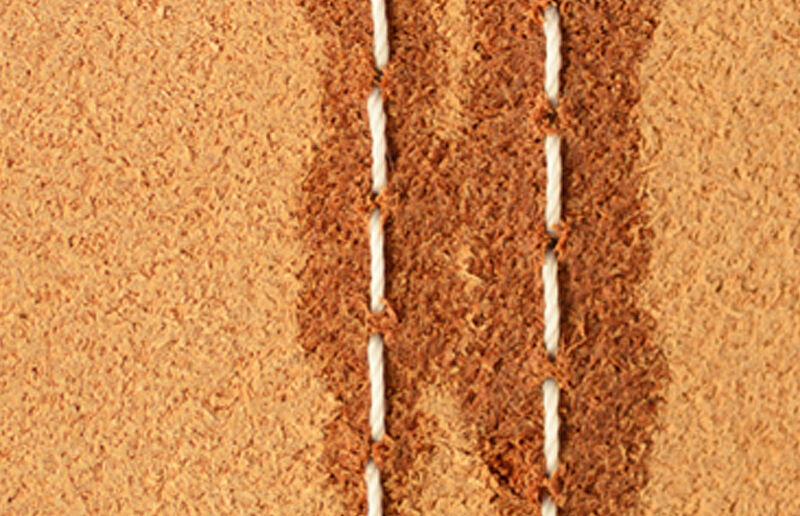
- Capillary effect with normal sewing thread
- The thread absorbs water, which is sucked/transported through the sewing thread via the stitch holes to the underside of the seam.
All AMANN sewing threads with water-repellent finish are certified according to STANDARD 100 by OEKO-TEX® and do not contain any PFAS (per- and polyfluorinated alkyl substances). AMANN's WRe finish can be applied to all AMANN sewing threads – it is wash-resistant and has no negative impact on sewability.
Factor 2: The sewing needle
Choosing the right sewing needle also affects the impermeability of the seam. It is also important to note that the needle size should be selected according to the thickness and type of material and the thickness of the sewing thread. For fabric, the use of round points (R or RG) is recommended. Cutting points are not suitable as they cut through the outer fabric when inserted. This leads to unnecessarily large holes, through which water can enter, especially when the seam is under strain. The needle point should be checked regularly and replaced if necessary. Damaged needle points can cause unwanted damage to the material.
To keep the stitch hole as small as possible, the smallest possible needle size should be used. This prevents water from being forced through from the outside through a stitch hole that is too large. The following image shows a seam with stitch holes that are too large.
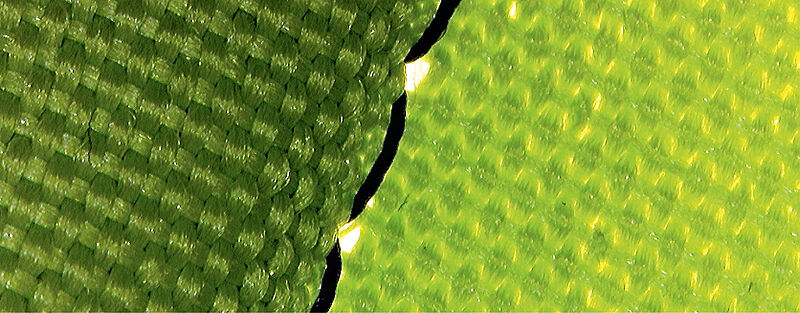
If water comes into contact with seams with stitch holes that are too large, it can pass through unhindered, even if water-repellent sewing threads have been used, because the water passes by the sewing thread.

Factor 3: The material
Furthermore, seam impermeability is significantly influenced by the properties of the materials used (mainly the outer fabric). If, for example, the materials are not water-repellent, in the worst case scenario water can drip right through the entire fabric surface. In such cases, even waterproof seams are of no help. If the outer fabric is water-repellent but is damaged by the needle entry or other factors, water can penetrate through these weak points despite other parameters being optimal.
Factor 4: The stitch type
Another criterion for seam impermeability is the stitch type. This is decisive for sealing the stitch hole. The double lockstitch (stitch type 301 according to ISO 4915) is particularly well suited for water-repellent seams, as the stitch interlocking of the needle and bobbin thread occurs in the middle of the fabric. This fills the stitch hole optimally, as shown in the following sketch.
Double lockstitch, stitch type 301

Factor 5: The seam construction
Last but not least, seam impermeability is influenced by the seam construction. The most common seam types used for waterproof seams are the normal closing seam, the topstitched seam and the flatlock seam. We conducted various tests to determine the influence of seam construction on seam impermeability. This resulted in the following findings:
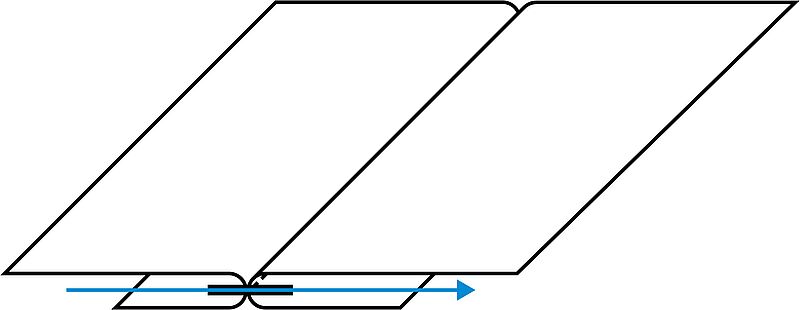
Seam position for a normal closing seam
The standard closing seam commonly used in clothing manufacturing offers optimum waterproofing. Neither the closing seam nor the sewing thread come into direct contact with water.
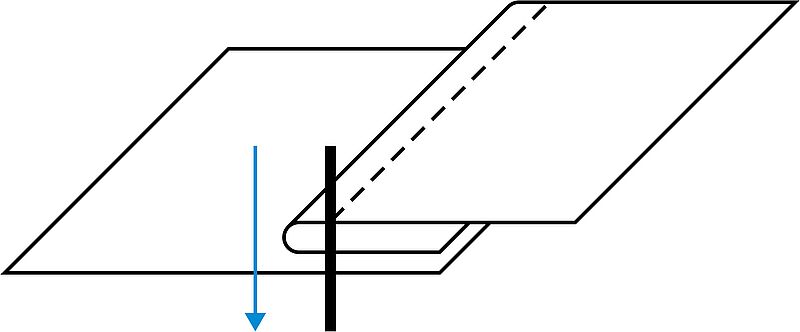
Seam position for a topstitched seam
The topstitched seam frequently used in the awning industry poses an increased risk of water penetration due to the vertical position of the stitch holes. If water-repellent sewing thread is not used, the first drops of water can penetrate through the stitch holes after just a few minutes.
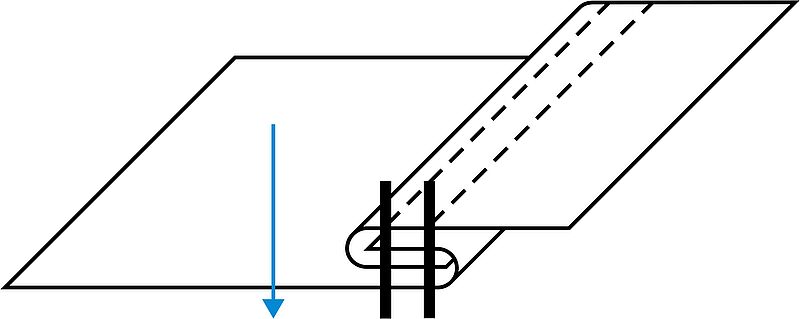
Seam position for flat-felled seams
With flat-felled seams (especially on smooth materials), water can penetrate through the folded layers of fabric if the water pressure is high enough.
Water-repellency test
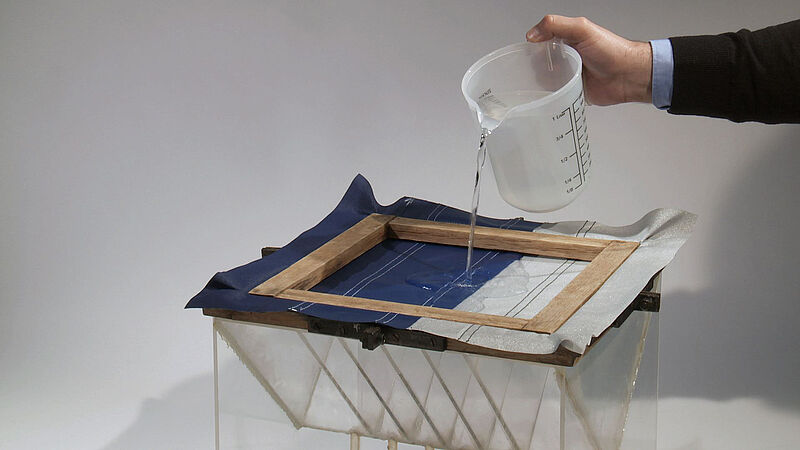
A simple method for testing and checking seam impermeability is the water-repellency test developed by AMANN. The sample seam is clamped into a tensioning frame and loaded with one litre of water. Since the test specimen is statically clamped, the seam is not under tensile stress, as it would be in a ‘real’ application, such as a tent, jacket or shoe.
It is now necessary to observe when and where exactly the first water droplets form on the underside of the material. On the one hand, water droplets can pass through the stitch holes. However, it is equally possible that the water finds its way through the layers of fabric, regardless of the sewing thread and stitch holes. The worst-case scenario is when the water passes through the entire fabric surface to the underside. If all parameters are optimally coordinated, the water remains in the tensioning frame and does not penetrate the fabric or stitch holes.
It is important to note that these results only apply to the materials and sewing parameters used in each case. Since every material and all influenceable sewing parameters can affect the seam impermeability, individual tests are necessary to select the best possible combination.
Summary
- When using sewing threads without a water-repellent finish, water will penetrate the seams after only a short time.
- When using water-repellent sewing threads, water penetration can be delayed to such an extent that the seams maintain their impermeability for 24 hours or longer.
- A 100% watertight seam can only be achieved by gluing/welding underneath (‘taping’).
- The smallest possible needle size should be used to keep the stitch holes as small as possible.
- The denser the material, the better the seam impermeability.
- Only water-repellent materials should be used. In the case of coated outer fabrics, even water-repellent sewing thread may not achieve a 100% watertight seam if the coating is damaged by the needle puncture.
- The double lockstitch is particularly suitable as it seals the stitch hole optimally with good thread balance.
FAQ
-
Seam performance in wet conditions depends on five interacting components: sewing thread, needle, material, stitch type and seam construction.
-
No. Even water-repellent thread cannot prevent leakage if the needle size is too large, the fabric is unsuitable, or the seam construction exposes stitch holes directly.
-
A larger needle creates larger stitch holes, which increase the risk of direct water penetration. Using the smallest possible needle size reduces this risk.
-
If the outer fabric is not water-repellent or sufficiently dense, water can penetrate through the fabric surface regardless of the seam setup.
-
The double lockstitch (stitch type 301 according to ISO 4915) is especially suitable because the thread interlocking occurs in the centre of the material thickness, helping to fill the stitch hole effectively.
-
Yes. A standard closing seam generally offers better protection, while topstitched seams or flat-felled seams may increase the risk depending on exposure and water pressure.
-
If stitch holes are too large or the seam construction exposes them directly to water, moisture can bypass the thread entirely.
-
Yes. Denser materials generally reduce the likelihood of water penetration at the seam.
-
No. Fully waterproof seams require additional sealing methods such as taping, welding or bonding.
-
Because seam performance is a system result. If one parameter is poorly selected, it can compromise the overall resistance of the seam.