
Intro
Embroidery is much more than just decoration. It enhances textiles, adds a personal touch, and is increasingly used to fulfil functional requirements in technical applications. The wider the range of applications, the greater the demands placed on the quality, productivity and colour consistency of embroidery.
High-precision results require several components to work together perfectly, including stitch types, the digitizer, the embroidery machine, the thread, the material to be embroidered on and the backing. The interaction between digitizing software and the embroidery machine is particularly crucial. It determines whether an embroidery design will be clean and distortion-free with sharp contours or whether production problems will occur.
This article explains how the digitizing process affects the performance of embroidery machines, and why professional digitizing is the foundation of reliable embroidery production.
The digitizer – turning design into a digital embroidery file
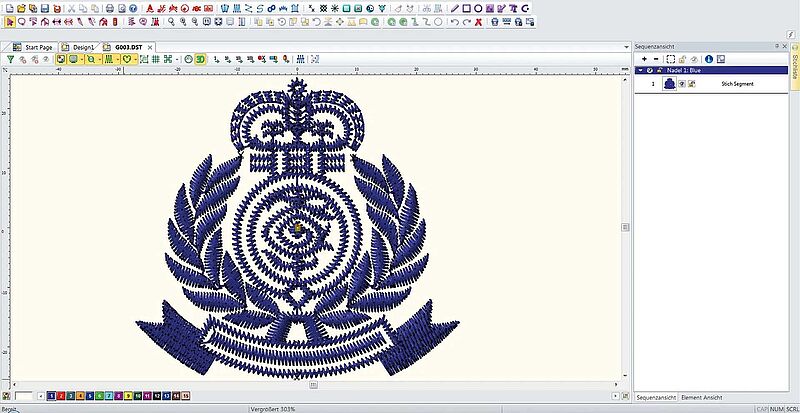
In order to visualise an embroidery design, the digitizer must convert the desired object into a digital format. To do this, they construct the embroidery pattern from the three types of stitches described above and set them up. The digitizer must have a thorough knowledge of the embroidery materials and customer requirements in order to set the correct parameters. The digitizer's skill is primarily responsible for the quality of the embroidery. Colour shades, for example, can be achieved by varying the embroidery direction and stitch length.
The embroidery machine – converting the digital file into reality
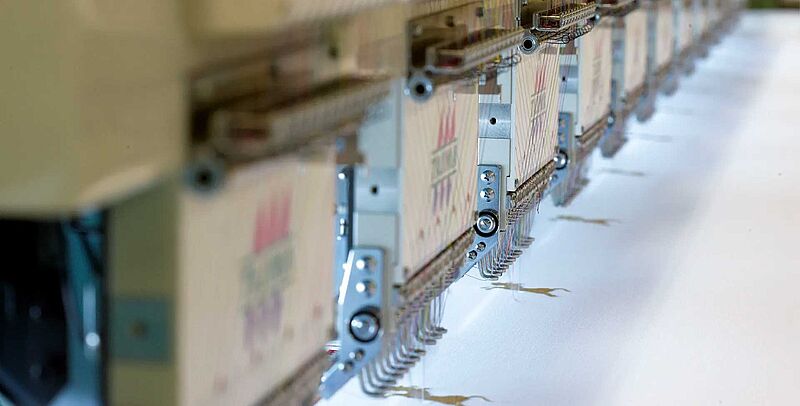
The file created by the digitizer is converted into the finished embroidery by the embroidery machine in conjunction with the thread, embroidery base and backing. A distinction is made between:
- Number of heads: One embroidery pattern can be completed at a time per head. Machine sizes with one to 72 heads are common.
- Number of needles per head: The number of needles indicates the maximum number of colours that can be embroidered in a sample without changing the machine in between. Needle counts between one and 18 are common, with the majority being around twelve needles.
- Embroidery word area and frame size: These define the largest possible embroidery designs.
The embroidery speed (currently 200–1800 stitches per minute are possible) and additional features such as sequin, drill or cord embroidery devices are further important characteristics of embroidery machines. Embroidery machines generally require a finely adjustable and accurate thread tension device. The thread tension should always be set as low as possible. The thread balance is usually correct when 1/3 of the area on the back of a satin stitch is formed by the bobbin thread. When using high-quality embroidery thread, such as Isacord with its low and extremely consistent sliding values across all colours, it is not necessary to readjust the thread tension when changing colours.
The backing – the hidden foundation of stable embroidery
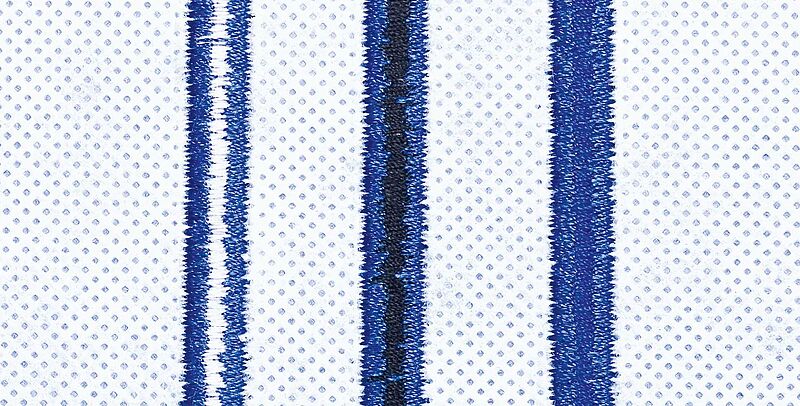
The backing serves to enable distortion-free embroidery with sharp contours. It is applied to the underside of the outer fabric and, in conjunction with the underlay stitches, gives the embroidery base the necessary dimensional stability. Depending on its type and properties, it can be removed after embroidery by tearing, cutting or dissolving. For materials with nap, the backing can be supported by a soluble film on the upper side of the embroidery fabric. A water- or heat-soluble backing or a corresponding film prevents the stitches from sinking into the nap.
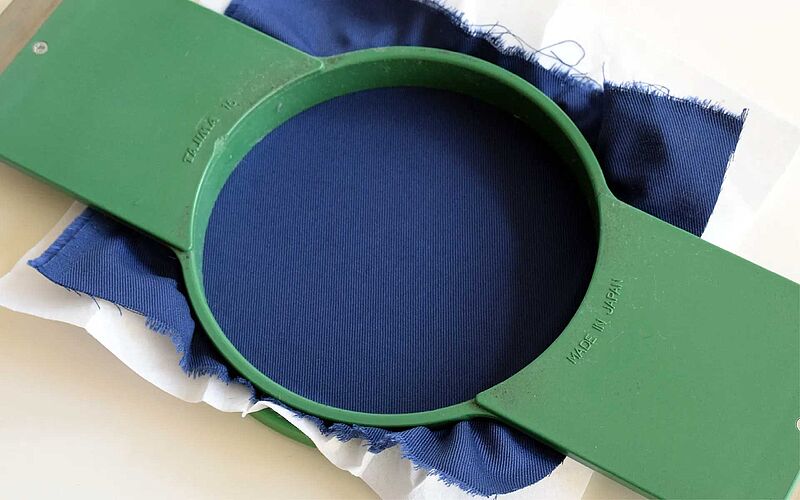
The following table provides guidance on the use of the various backings (differences are possible).
| Material | Backing |
|---|---|
| Knitted fabric; very finely woven fabric | Cut-away backing to prevent damage to the material when tearing away |
| Woven fabric, stable knitwear | Tear-away backing |
| Transparent materials, embroidery that can also be seen from the back | Water- or heat-soluble backing for residue-free removal |
| Terry cloth, velvet, velour | Tear-away or cut-away backing and water-soluble film on the top side |
The needle – a small component with huge impact on embroidery quality
The DB x K5 needle system has become established worldwide for machine embroidery. Fortron® machines are an exception. The eye of the needle is enlarged by one or two needle sizes in the DB x K5 system. A 70 needle therefore has the eye of an 80 or 90 needle, which has several advantages:
- Better protection of materials
- Smaller needle diameter available
- Better protection of embroidery thread thanks to more space in the needle eye
- Easier threading of the needle
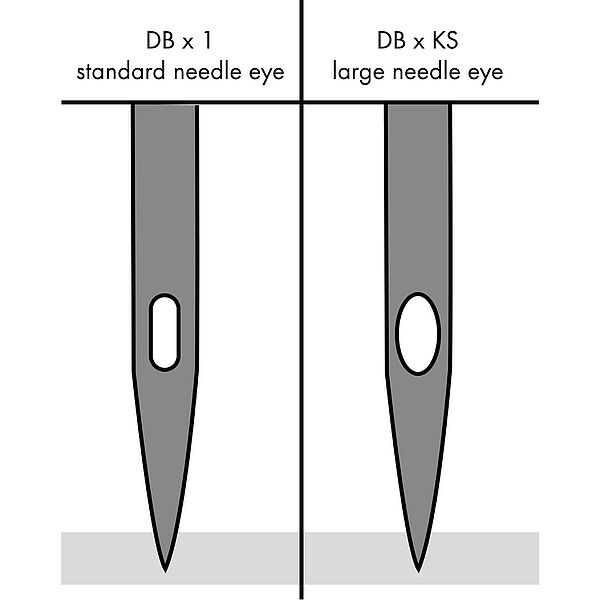
The needle size designation Nm commonly used in Europe divided by 100 gives the diameter of the needle shaft in mm. A 70 needle therefore has a diameter of 0.7 mm. Needle sizes from 55 to approximately 120 can be used on conventional embroidery machines. The needle point is selected depending on the embroidery application. The small ball point can be used as the starting point. When machine embroidering, cutting points are generally avoided in order to prevent perforation of the material.
The following table provides guidance on selecting needle points and sizes. Exceptions and differences are possible depending on the material and workmanship.
| Needle size | Needle brand | |||||
|---|---|---|---|---|---|---|
| Material | Nm | Size | Needle point | Groz-Beckert | Organ | Schmetz |
| Knitwear | ||||||
| Knitwear & jersey | 65-80 | 9-12 | medium or small ball point | FFG/RG | J/Q | SES |
| Finely knitted fabric | 60-75 | 8-11 | medium or small ball point | FFG/RG | J/Q | SES |
| Woven fabric | ||||||
| Fabrics for shirts/blouses | 55-70 | 7-10 | sharp or small ball point | R/RG | R/Q | R |
| Denim | 70-110 | 10-18 | sharp or small ball point | R/RG | R/Q | R |
| Terry cloth | 65-90 | 9-14 | sharp or small ball point | R/RG | R/Q | R |
| Mircro-fibre | 60-90 | 8-14 | sharp or small ball point | R/RG | R/Q | R |
| Silk | 60-80 | 8-12 | sharp or small ball point | R/RG | R/Q | R |
| Leather goods | ||||||
| Leather | 70-110 | 10-18 | sharp ball point | R | R | R |
| Synthetic leather | 65-90 | 9-14 | sharp ball point | R | R | R |
| Coated materials | 65-100 | 9-16 | sharp or small ball point | R/RG | R/Q | R |
FAQ
-
Digitizing converts a design into a machine-readable embroidery file and defines stitch structure, direction, density and length.
-
Yes. The quality of the final embroidery largely depends on the digitizer’s expertise and parameter settings.
-
Running stitches, satin stitches and fill stitches form the technical foundation of embroidery files.
-
Stitch direction, density and length affect light reflection, colour appearance, contour sharpness and dimensional stability.
-
Yes. Optimized stitch length and fill structures can reduce stitch count and improve production efficiency.
-
The machine converts the digital file into physical stitches under real production conditions.
-
Unsuitable digitizing parameters for a specific machine setup can cause distortion, thread breaks or uneven coverage.
-
Correct thread tension ensures balanced stitch formation and reduces thread breakage.
-
In satin stitches, approximately one third of the stitch formation on the back should be bobbin thread.
-
Frame size, number of needles and machine speed must be considered to avoid design or production limitations.