
Intro
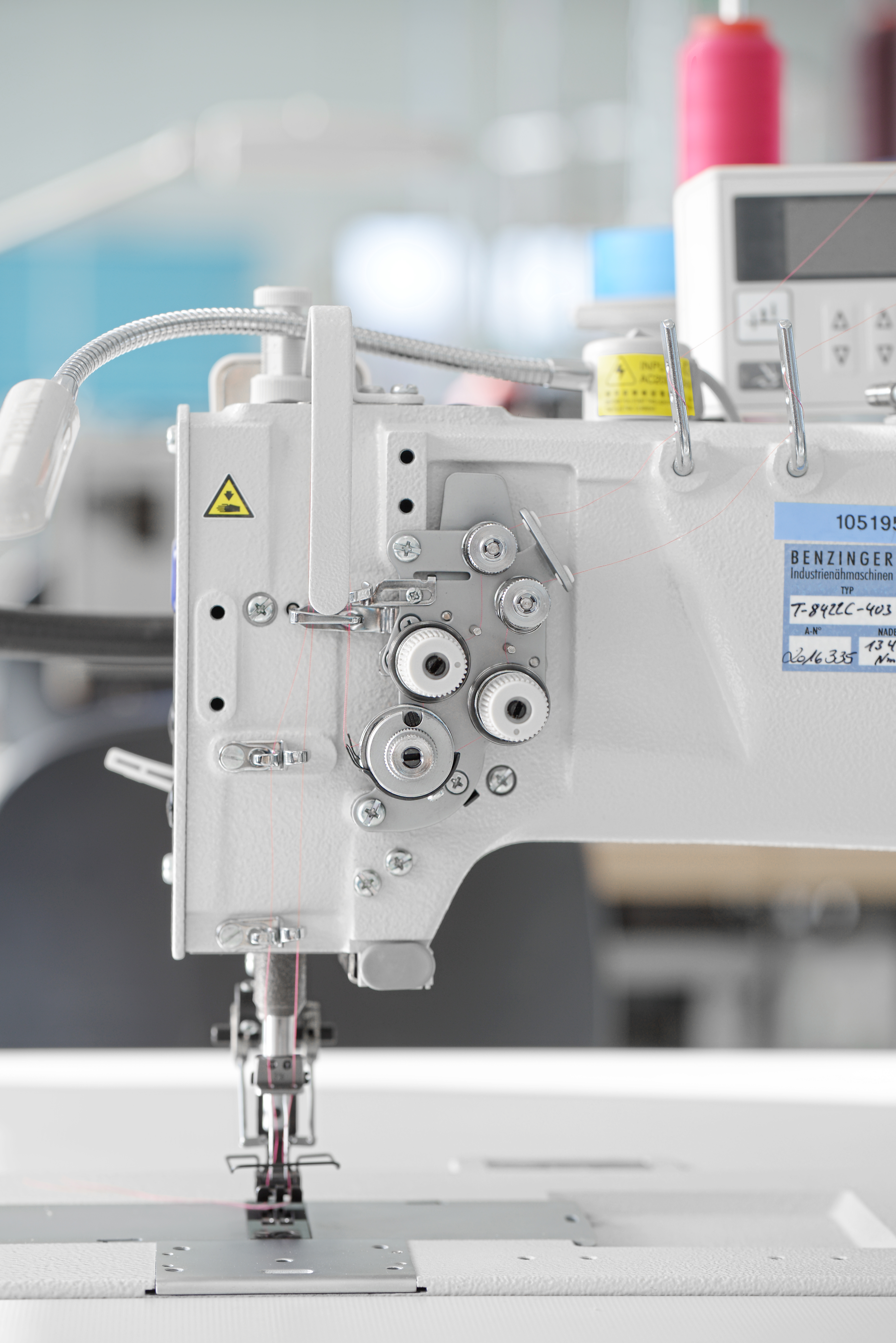
Correct needle thread tension is one of the most important prerequisites for consistent seam quality. An unfavorable thread balance can often be identified by unpicking the seam, and in many cases, it can be corrected by adjusting the thread tension.
However, the challenge in practice is not only adjusting the tension but also ensuring that the optimum thread tension can be reproduced reliably. For this reason, it is essential to make thread tension measurable directly on the sewing machine using a thread tension measuring device.
Measuring the needle thread tension
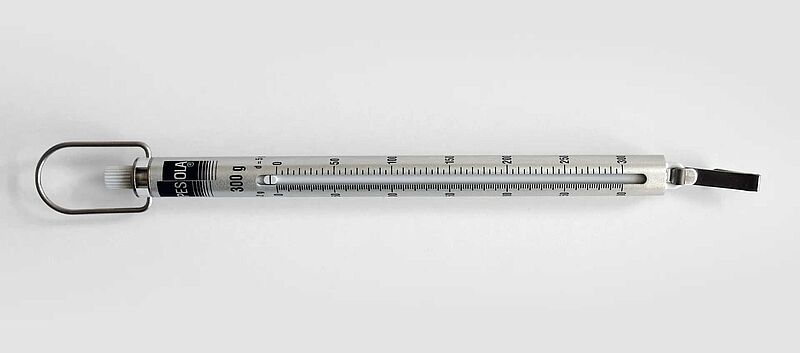
There are two common thread tension measuring devices available (www.hans-schmidt.com; www.pesola.com). The PESOLA thread tension measuring device is more convenient and significantly less expensive.
The following procedure describes how the PESOLA device is used to determine needle thread tension.
Preparation
Before measuring the needle thread tension, the sewing machine must be correctly prepared. Correct preparation is essential to ensure that the measurement result is accurate and repeatable.
Step 1: correct threading
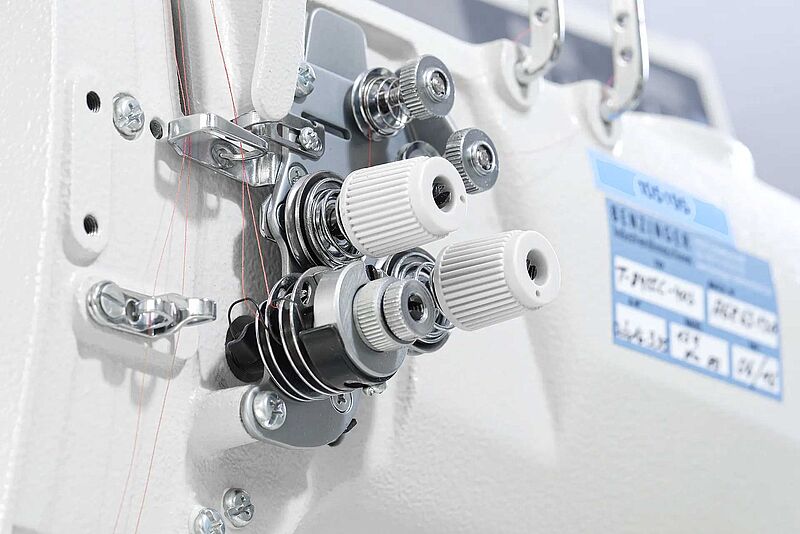
The sewing machine must be threaded correctly.
Step 2: correct spool position
The cones/spools must be positioned correctly on the spool stand, using the spool plate if necessary.
Step 3: correct adjustment of the spool stand
The spool stand must be correctly adjusted. This means the first thread guide should be positioned directly above the center of the spools.
Step 4: take-up lever position
The take-up lever must be at the upper reversal point.
- On machines with a thread trimmer, the take-up lever usually remains automatically at the upper reversal point after the trimming process.
- On machines without positioning and thread trimmers, the take-up lever must be moved to the upper reversal point using the handwheel.
Measuring procedure
Once the sewing machine is prepared, the measurement can be carried out.
Step 1: secure the thread
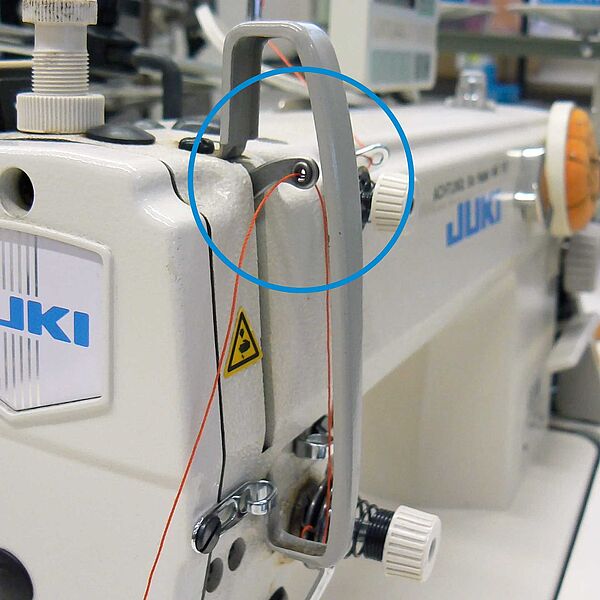
The thread must be pulled out a few centimeters via the thread guide in the take-up lever and secured in the thread clamp of the tension measuring device.
The thread must be firmly secured in the thread clip and must not slip through when it is pulled through later.
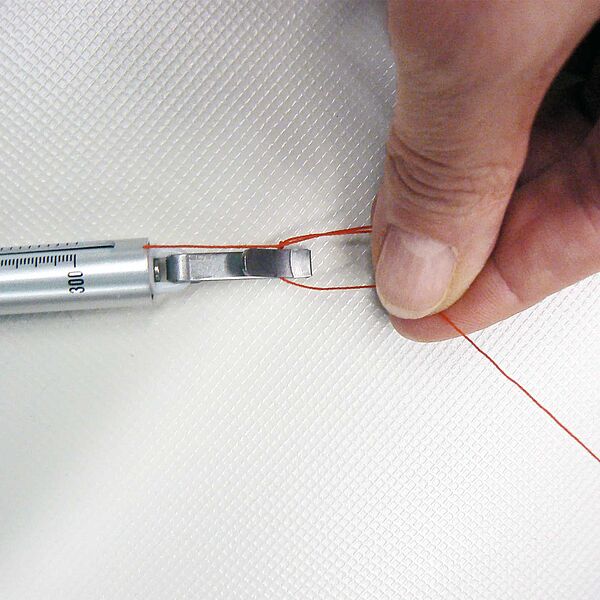
A knot or a loop may help when fixing the thread.
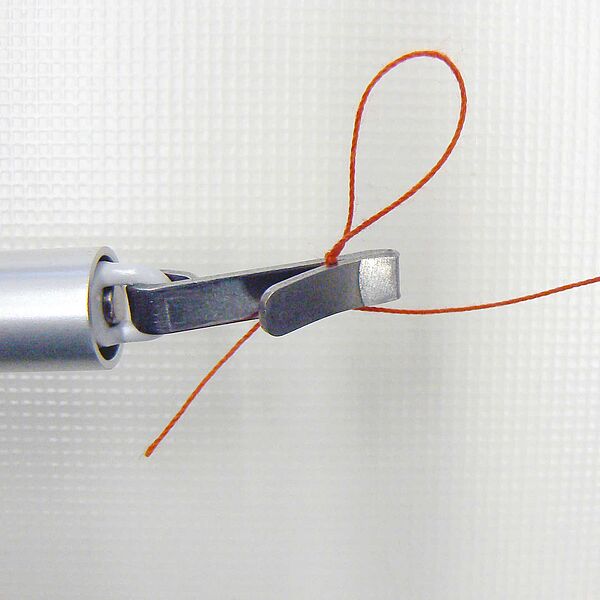
Step 2: pull the measuring device
Now pull the tension measuring device evenly horizontally to the left (away from the take-up lever) at the height of the take-up lever.
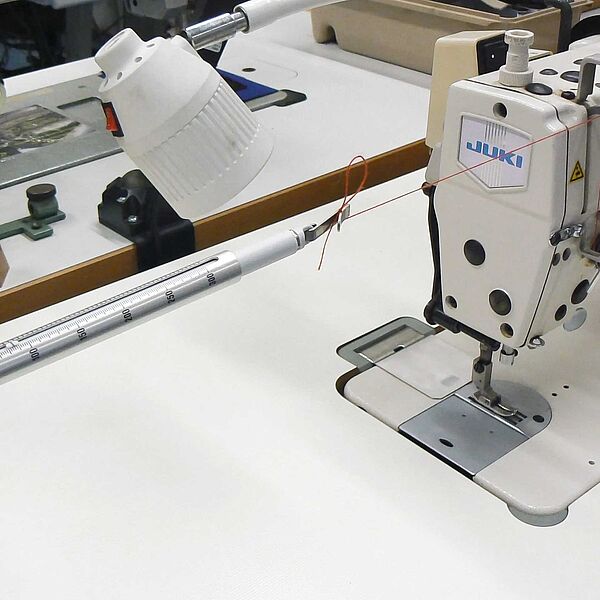
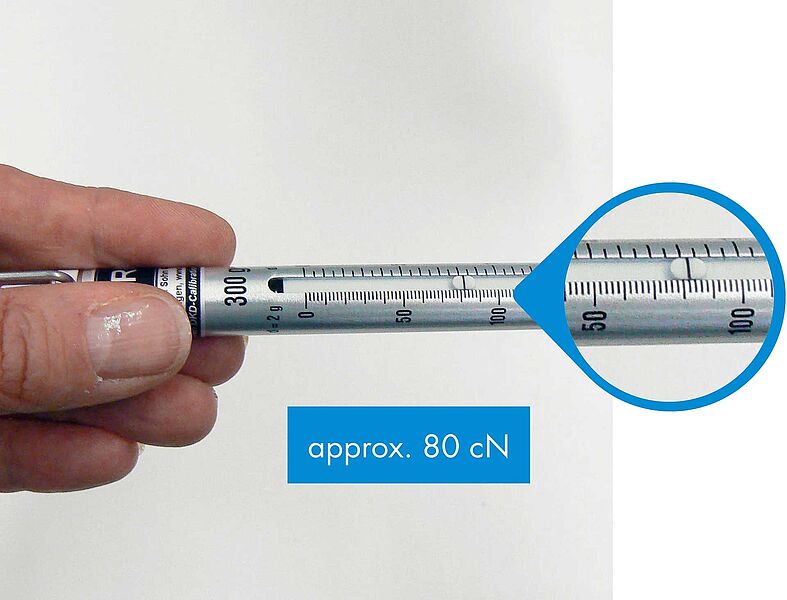
The tension measuring device must be held as shown in the instruction picture.
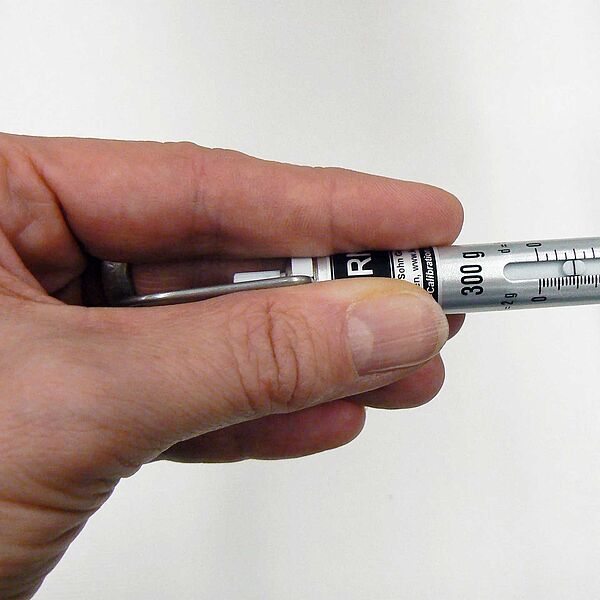
Step 3: read the tension value
During this movement, the current thread tension can be read off on the display in cN.
This value represents the needle thread tension setting currently applied on the machine.
Important notes for reliable results
When measuring and evaluating needle thread tension, the following points must always be considered:
- Different sewing thread tickets require different thread tension settings.
For example, the thread tension for Saba 80 differs from the tension value for Saba 30. - The thread tension values determined can only be transferred between identical machines (manufacturer and class/type).
- The optimum thread tension for a seam depends on the requirements for the seam (e.g. appearance, strength, etc.) and is always a combination of needle and bobbin thread tension.
- With sewing threads that have a textile character (e.g. Saba), the display on the thread tension device usually fluctuates due to the surface structure.
- With sewing threads that have a very smooth surface (e.g. Serafil), the fluctuations on the display are extremely small.
Conclusion
Measuring needle thread tension is an effective method to make sewing machine settings reproducible and technically controllable. By using a thread tension measuring device, the optimum thread tension can be determined specifically on the sewing machine and documented in a measurable way.
Correct preparation, proper handling of the measuring device and consideration of thread type and ticket size are essential for reliable results. Since thread tension is always linked to the thread balance of the seam, needle and bobbin thread tension must always be evaluated together.
A measurable needle thread tension is therefore a key requirement for stable processing and consistent seam quality.
FAQ
-
Repeatable seam performance requires measurable and reproducible needle thread tension settings.
Using a thread tension measuring device directly on the sewing machine allows the current tension value to be read in cN and documented. Proper machine preparation — correct threading, spool positioning, spool stand adjustment, and take-up lever positioning — is essential for accurate and consistent results.
-
Measuring needle thread tension makes sewing machine settings technically controllable and reproducible.
Without measurable values, adjustments remain subjective and difficult to repeat. A defined tension value ensures stable processing conditions and consistent seam quality across identical machines.
-
The sewing machine must first be properly prepared: correct threading, correct spool positioning, correct spool stand adjustment, and positioning the take-up lever at the upper reversal point.
The thread is then secured in the measuring device clamp and pulled horizontally at the height of the take-up lever. The current needle thread tension can be read in cN during this movement.
-
Thread tension values can only be reliably transferred between identical machines of the same manufacturer and class/type.
Different machine constructions influence tension behavior. Therefore, measured values should always be documented per specific machine type.
-
Different sewing thread tickets require different tension settings.
For example, the required tension for a finer thread differs from that of a coarser thread. Threads with a textile character may show display fluctuations during measurement, while very smooth threads typically produce more stable readings.
-
No. Needle thread tension must always be evaluated together with bobbin thread tension, as both determine the overall thread balance of the seam.
The optimum setting depends on seam requirements such as appearance and strength. Only the correct combination of needle and bobbin tension ensures consistent seam quality and stable processing.