
Intro
In order to optimally support the sewability of sewing threads and embroidery threads, it is particularly important to design the make-up appropriately. There are a variety of different make-ups that are individually tailored to the sewing industry with its manufacturing processes and machines. The purpose of the make-up is to:
- support trouble-free unwinding of the thread (without snagging or sticking),
- offer lengths (unit lengths) that meet requirements,
- provide an option for thread storage for special areas of application.
On almost all sewing and automated machines, the sewing and embroidery threads are delivered from the top of the spool. The make-up must therefore ensure an unhindered and trouble-free thread delivery, even at high sewing speeds and in cases of partially inconsistent traction.
In general, thread make-ups are offered in length units (1,000 m, 5,000 m, 10,000 m or more). Only in rare exceptions are they offered by weight (e.g. 1 kg or 25 g), and these can only be found in individual cases. The range of different lengths per article can be very large and reflects the requirements of the various industries.
The fashionable apparel industry, with its small production quantities and wide variety of colours, requires small make-ups in order to supply multiple sewing machines simultaneously and to minimize excess quantities at the end of a season. The mattress industry, with its multi-needle quilting machines, high thread consumption, and limited colour range, however, needs long lengths in order to achieve minimal rethreading times and thus high profitability.
In general, the same applies to sewing threads for overlock seams, or for sewing threads used in the underwear industry with its high thread demand. Each application field has its clearly defined requirements for the optimal make-up style. Accordingly, specific make-up sizes have been established that are practical, profitable, and cover almost all market requirements. At the same time, new make-up styles are constantly being developed as needed for new production methods, sewing machines, or changing market demands.
The design of the make-up in terms of shape and size must be tailored to the different sewing threads and their properties, as well as to the sewing machines. Sewing threads with a textile, fibrous surface can be wound differently than sewing threads with a smooth surface. Multi-needle machines or embroidery machines, some of which have limited space, place different demands on the shape of the make-up than single-needle machines with ample space for the sewing thread spool.
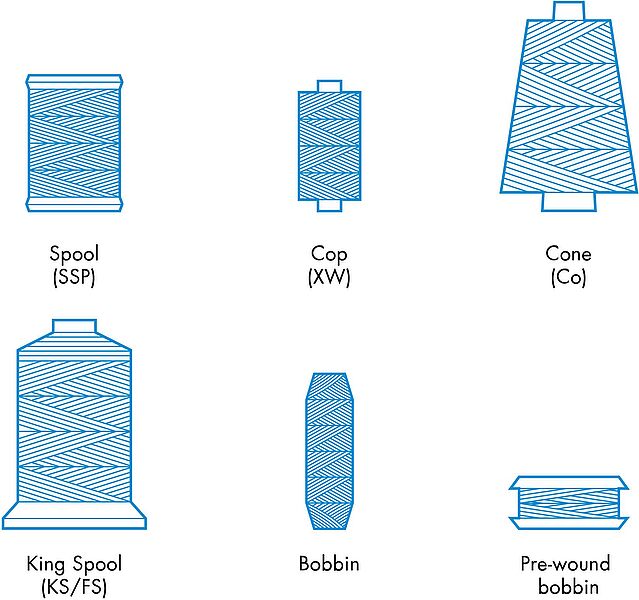
The following illustration shows an overview of the different types of make-ups.
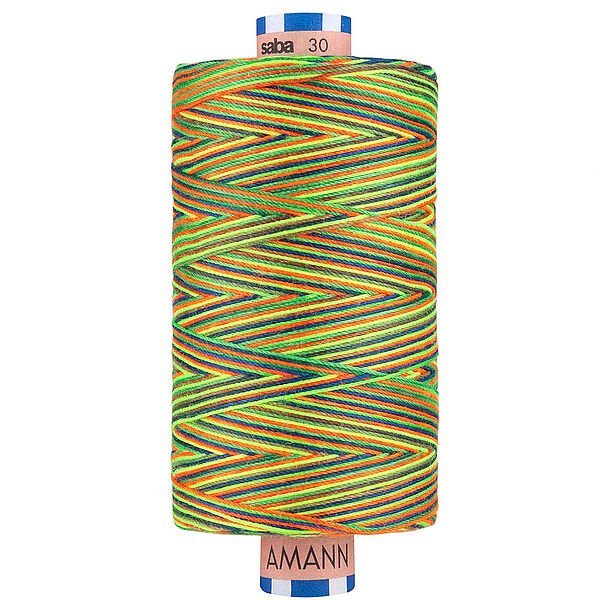
Cops
For cops (XW), the sewing thread is crosswound on parallel tubes. Cops ensure a constant thread delivery even at high sewing speeds. This make-up style is used in various fields of application, especially in the apparel industry. When there is a need for a large range of colours in small production quantities, the cop is the ideal choice of make-up. With a maximum length of 1,000 m, the cop represents a small packaging unit that meets the requirements of profitability and high colour flexibility. Most core spun threads and spun threads are offered on cops.
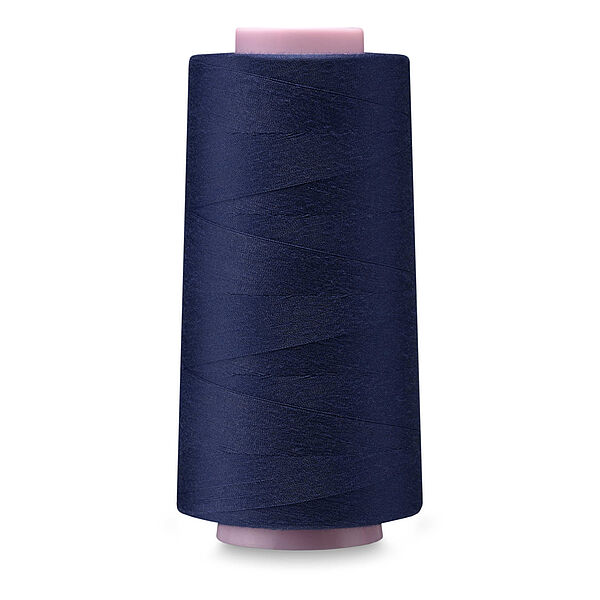
Cones
Cones (Co) are cone-shaped tubes of different sizes, depending on the thread lengths they hold. The thread is also crosswound to ensure a trouble-free thread delivery, even for very long lengths.
The cone has the capacity to hold longer lengths, and a wide range of thread lengths is available depending on market requirements and thread strength. Typical cones for the apparel industry are make-ups of 5,000 m and 10,000 m, while 20,000 m and 30,000 m cones are used for overlock seams and underwear applications. Consequently, coarser threads have shorter length capacities.
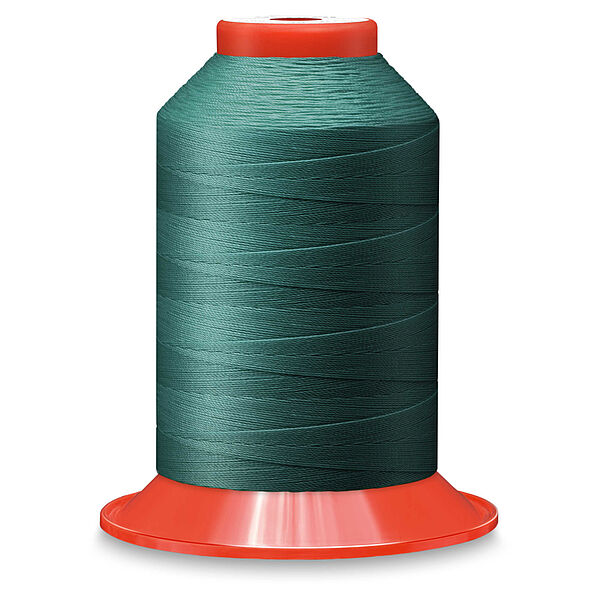
King spools
King spools (KS) are cylindrical tubes with a cone-shaped foot on the narrow bottom side, serving as a platform. Because of their shape, they are often referred to as foot spools (FS). These are the traditional make-ups for continuous filament threads.
Due to the smooth surface of these threads, there is a risk of spillage (thread layers slipping from the thread body) during sewing operations or downtimes. The spool’s foot, together with the usually incorporated receiving groove, contains any spillage and thus guarantees a perfect off-winding performance.
The sizes of king spools can vary depending on the sewing thread size and make-up style. In addition to mini king spools that hold only a few hundred meters, there is a wide range of standard spools available for various lengths, from 300 m up to 20,000 m, depending on the thread size and required quantities.
Some king spools also offer an additional option for thread storage.
The end of the thread can be secured in a so-called snap groove to prevent the thread layers from falling off during transport or storage. This additional feature is particularly important for embroidery threads, as they are rarely used up completely and it is common practice to store the opened spools again after finishing the embroidery job.
There are two standard lengths for embroidery threads: the 1,000 m mini king spool and the 5,000 m king spool.

Pre-wound bobbins
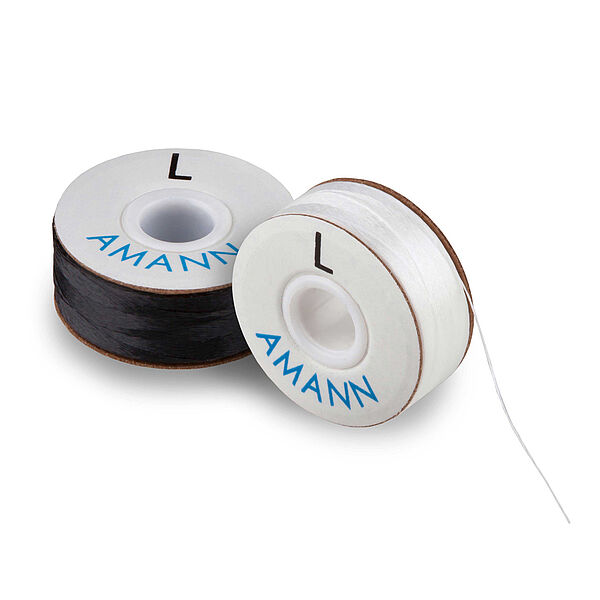
As a time-saving alternative to conventionally wound metal bobbins, pre-wound bobbins are primarily used in the embroidery industry.
Since the underthread is not visible from the front side of the embroidery, the most commonly used underthread colours are black and white. Because only two colours are typically needed, pre-wound bobbins for automated multi-head embroidery machines are far more common than for automated sewing machines.
The so-called embroidery bobbins are supplied in packaging units of 144 pieces (equivalent to one gross). Fine spun threads or continuous filament threads are used to achieve long running lengths. There are two types of pre-wound bobbins: unsupported bobbins, which require a light bonding to secure the continuous filament thread package, and bobbins with cardboard side edges, which need no additional handling.
We recommend using non-bonded bobbins, as they provide a smoother off-winding performance. Pre-wound bobbins are available in two sizes: L and M, with M being the larger and L the smaller size. Size L is the most commonly used for embroidery machines worldwide. With Isabob 190, AMANN offers a slightly bonded bobbin that provides excellent off-winding properties and a long running length.
Make-up aid
To further support proper thread withdrawal, AMANN offers suitable spool holders for all types of make-up. These ensure that the sewing thread is perpendicular to the thread stand. This prevents thread layers from getting caught under the sewing thread spool. The spool holder ensures even thread withdrawal without tension peaks. If the spool were positioned at an angle, the sewing thread would stick unevenly to the front side.
The AMANN range includes a special plastic cover for large Transfil disc spools, colloquially known as a ‘container’ or ‘bell’. This protects and controls the thread balloon that forms when the thread is pulled out, ensuring optimum sewability.
In special cases, mesh tubes are placed over the sewing threads or embroidery threads to stabilise the thread withdrawal. In the case of metallic embroidery threads, mesh tubes reduce the formation of curls in the stiff wrapped threads. For this reason, the corresponding mesh tubes are included in every sales box of Isamet embroidery products. It should be noted that the spool itself should stand on the lower edge of the mesh so that the mesh cannot slip.


FAQ
-
Make-up refers to the packaging and winding format of a sewing or embroidery thread, including its shape, size and length unit.
-
The make-up ensures smooth and trouble-free thread unwinding, even at high sewing speeds and under varying thread tension.
-
A make-up is designed to:
• ensure reliable thread delivery,
• provide suitable length units,
• support storage and handling requirements for specific applications. -
Different industries have different consumption rates, colour ranges and machine types. Small production runs require shorter lengths, while high-volume industries need longer running lengths to minimise downtime.
-
Sewing and embroidery threads are generally supplied in defined length units (e.g. 1,000 m, 5,000 m, 10,000 m or more). Sales by weight are rare exceptions.
-
Multi-needle and embroidery machines may have limited space and specific unwinding requirements, while single-needle machines often allow larger formats. The make-up must match the machine configuration.
-
Most sewing and automated machines withdraw the thread from the top of the spool. The make-up must therefore allow smooth, vertical and tension-free thread delivery.
-
Improper make-up can lead to snagging, thread layer slippage, tension peaks or uneven unwinding, which may result in sewing problems.
-
Threads with a textile or fibrous surface can be wound differently than smooth continuous filament threads, which may require special spool shapes to prevent layer slippage.
-
Certain applications, especially embroidery, require partial usage and re-storage of threads. Integrated features help secure thread ends and prevent unwanted unwinding.
-
Pre-wound bobbins are primarily used in embroidery to reduce downtime and ensure consistent underthread supply, especially in automated multi-head machines.
-
Spool holders ensure correct thread alignment and prevent uneven tension. Additional aids such as protective covers or mesh tubes stabilise thread withdrawal and improve sewability.