
Intro
The strength of sewing threads affects sewability and has a significant impact on seam strength. Sewing threads with low strength can break during the sewing process if the stresses, i.e. the forces exerted by the stitch formation, are too high. This can lead to disruptions in the production process or even production downtime, especially when sewing/embroidery machines are used. A distinction is made between the following strength terms and specifications:
Maximum tensile strength
The maximum tensile strength is the maximum linear tensile force that can be applied to a thread before it breaks. It is sometimes also referred to as breaking strength, breaking force or linear tensile strength.
It is measured using the simple tensile test in accordance with ISO 2062 and expressed in cN. The simple tensile test is one of the most important yarn or thread tests for compliance with specified quality requirements.
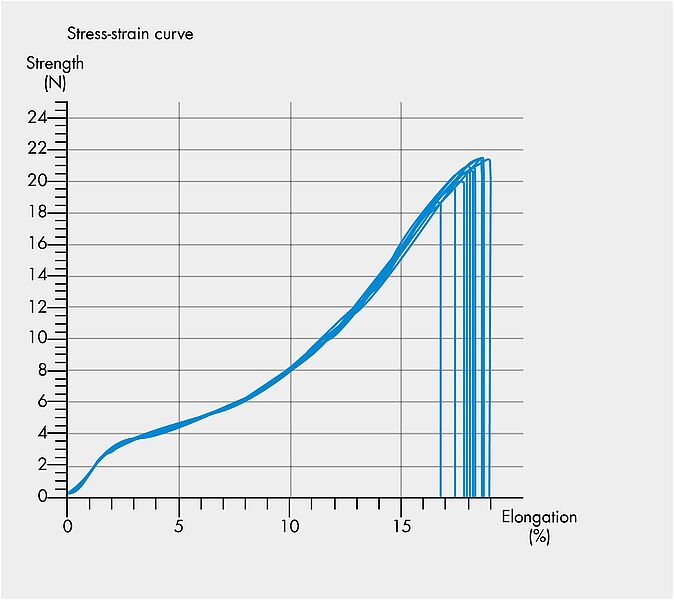
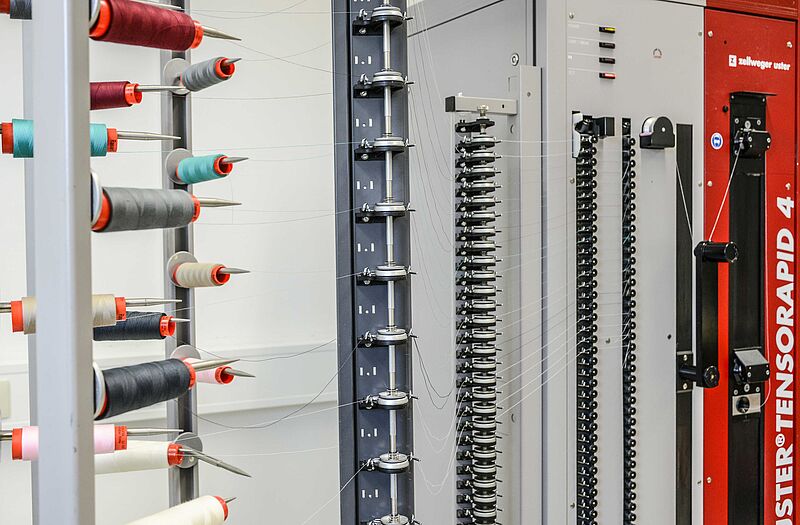
In AMANN's testing laboratories around the world, the maximum tensile strength test is performed more than 5,000 times a day on fully automatic tensile testing machines and evaluated using a stress-strain curve diagram. The curve of the diagram shows the elongation in percent and the effect of the force in newtons until the thread breaks. In the diagram shown, the values of several tests are superimposed. This considerable testing effort is necessary because, as a rule, all the different production stages – yarn, raw thread and finished thread – are tested in order to guarantee optimum quality.
When talking to technicians in the apparel industry, the maximum tensile strength is often given in grams or kilograms rather than centiNewtons or Newtons. Here, 1 g corresponds to ~ 1 cN and 1 kg corresponds to ~ 10 N. For many people, weight designations are still more common and easier to understand. Depending on the raw material, sewing thread type and linear density, AMANN products have very different levels of strength. The finest polyester continuous filament threads, such as Serafil fine 300, have a maximum tensile strength of approx. 640 cN; coarse polyester continuous filament threads can achieve maximum tensile strength values of over 20,000 cN (equivalent to 20 kg).
Maximum tensile strength related to linear density
The maximum tensile strength in relation to linear density is specified in cN/Tex for sewing threads and provides a comparison of the strength of different types of sewing thread.
Example:
Saba 120 has a linear density of 14 Tex × 2 and a maximum tensile force of 1,200 cN. This results in a maximum tensile force relative to linear density of 42.9 cN/Tex. (Calculation: 14 × 2 = 28; 1,200 : 28 ≈ 42.9)
An exemplary comparison of the maximum tensile strength (also known as tenacity) of different types of sewing thread clearly shows the varying strength potential depending on the raw material and thread construction.
| Product | Tenacity (cN/tex) |
|---|---|
| Polyester continuous filament (Serafil) | 50 to 65 |
| Polyester/polyester core spun (Saba) | 40 to 50 |
| Cotton spun (Mercifil GD) | 25 to 35 |
| Polyester bulk yarn (Sabatex) | 30 to 40 |
| Kevlar® continuous filament (Kc-tech) | approx. 160 |
Loop Strength
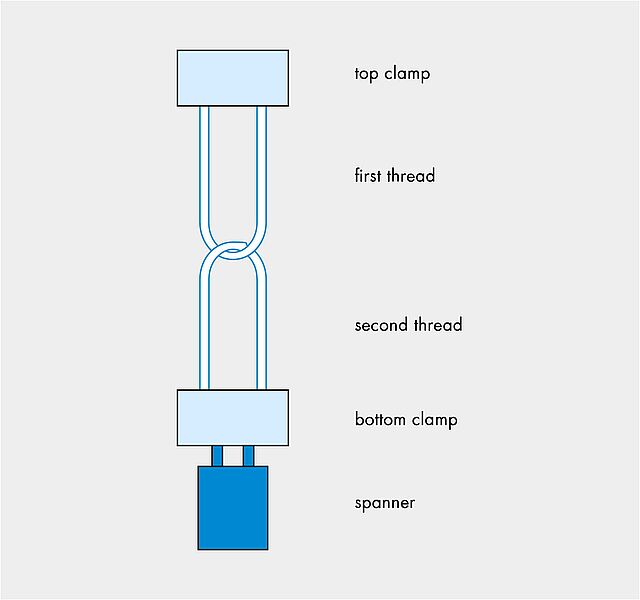
Loop strength is the tensile strength of sewing threads of the same linear density, which are stressed in the form of two loops hooked into each other in the tensile testing machine.
This test method is more closely related to the stresses on the sewing thread in the stitch formation looping of the seam than the linear tensile strength test using a simple tensile test.
The loop strength test subjects the sewing threads to different types of stress at the same time:
- tension in the longitudinal direction
- compression in the transverse direction
- bending around a very small radius
The sewing threads usually break at the point of looping, as the transverse strength of the fibres is lower than their longitudinal strength due to the fibre molecules being oriented in the longitudinal direction of the fibres. The relative loop strength is calculated from the ratio of the maximum loop tensile strength to the maximum tensile strength and is expressed as a percentage. Depending on the sewing thread construction, conventional sewing threads have a relative loop strength of approx. 60 to 75%. Spun threads generally have the highest relative loop strength, while continuous filament threads have the lowest.
Due to their raw material properties, para-aramid yarns have a very low loop strength of only approx. 40%. As a result, a significant portion of the very high linear strength is not effective in the seam. This must be taken into account when calculating seam strength.
Example: Saba 120 has a maximum tensile strength of approx. 1,300 cN and a relative maximum loop tensile strength of approx. 70%.
FAQ
-
Thread strength refers to the ability of a thread to withstand tensile forces without breaking. It is a key factor for seam durability.
-
Low-strength threads can break during sewing. This can cause machine stoppages and production issues.
-
It is the maximum force a thread can تحمل before breaking. It is usually measured in cN.
-
Loop strength measures how a thread behaves under looped stress conditions. It better reflects real seam stress.
-
Yes, raw material and construction significantly influence strength. Different threads show different performance levels.
-
It is tested using tensile tests according to ISO standards. These tests simulate stress until breakage.
-
No, not all strength is fully effective in the seam. Loop strength and construction must also be considered.
-
Higher strength improves seam resistance to stress. However, it must match the fabric and application.