
Intro
The elasticity of sewing threads has a direct influence on sewability and seam elasticity. Therefore, this quality feature is often the focus of attention. It is important to understand the correct use of the different terms used to describe this physical property.
Elasticity is basically divided into an elastic (reversible) and a plastic (permanent) component, with a smooth transition between the two. Elastic elongation is the portion of elongation that completely reverses after the load is removed.
Plastic elongation does not reverse after the load is removed. In common parlance, the former is referred to as elasticity and the latter as elongation.
At AMANN, elongation is determined in accordance with ISO 2062 by testing the maximum tensile force and is specified as maximum tensile elongation in percent on the product data sheet. The standard describes maximum tensile elongation as the change in length up to the breaking point of a sewing thread caused by tensile force in the longitudinal direction (in relation to the original length).
The overall course of the elongation behaviour is represented by the stress-strain curve diagram. Different types of sewing thread have different elongation behaviours and can be compared by superimposing the curves.

The elongation behaviour of sewing threads is determined by the selection of raw materials, the construction and the manufacturing process. Cotton threads such as MercifilGD have very low elongation of approx. 5 to 10%.
Sabaflex, AMANN's highly elastic sewing thread, has an elongation of approx. 60% thanks to its innovative raw material PTT, making it ideal for elastic seams. Standard sewing threads have an elongation of between 10 and 30% and are universally applicable. With the optimal combination of sewing parameters (stitch type, stitch density, thread tension, etc.), they are also suitable for elastic seams.
The two most important raw materials for sewing threads, polyester and polyamide, also differ in their elasticity. Polyamide sewing threads are known for their high elasticity. Polyamide continuous filament threads, such as Onyx, have a maximum tensile elongation of approx. 20 to 25%. In comparison, polyester threads have lower elasticity, depending on the sewing thread construction.
| Product | Maximum tensile elongation ( % ) |
|---|---|
| Polyester spun thread | approx. 12 to 15 |
| Polyester/polyester core spun thread | approx. 15 to 25 |
| Polyester/cotton core spun thread | approx. 15 to 25 |
| Polyester continuous filament | approx. 20 to 30 |
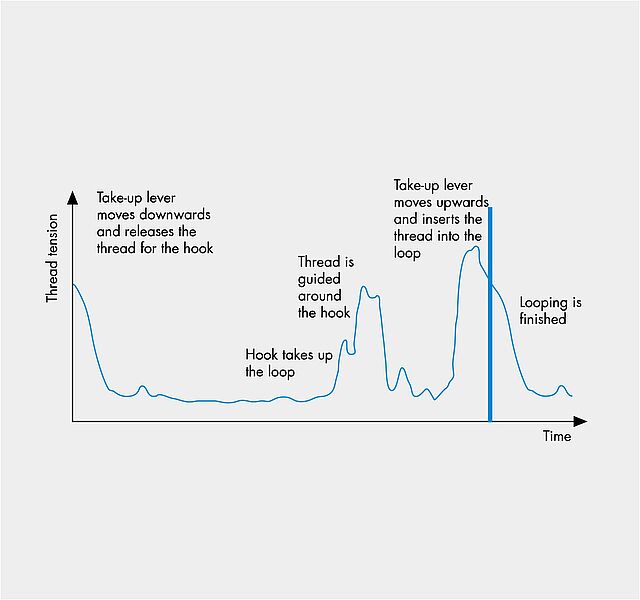
During the sewing process, different tensions (tensile forces) act on the sewing thread. Until the sewing thread is sewn in a double lockstitch, it is periodically exposed to up to 80 times this tensile stress, depending on the stitch density (see diagram below). This principle of operation results in two requirements for the elongation properties of sewing threads. On the one hand, the sewing thread must be able to compensate for the rapidly changing tension stress; on the other hand, the rebound of the sewing thread in the finished seam should be as low as possible to avoid tension puckering.
FAQ
-
Elongation describes how much a thread stretches under tension until it breaks. It is expressed as a percentage.
-
Elasticity refers to reversible stretch, while elongation includes permanent deformation. Both influence thread behavior.
-
It helps the thread absorb tension during sewing. This prevents breakage and improves seam performance.
-
Polyamide threads and special elastic threads offer higher elasticity. Cotton threads have lower elongation.
-
Higher elongation allows seams to stretch without breaking. This is important for flexible garments.
-
Yes, excessive rebound can cause tension puckering. Balanced elongation is required.
-
Raw material, thread construction, and production processes. These factors define stretch behavior.
-
Threads are exposed to repeated stress during stitching. They must adapt to changing tension conditions.