Intro
There is more than just one good choice. But how do you achieve the best result in each case? The following criteria serve as a guide for selecting the right sewing thread:
Optics
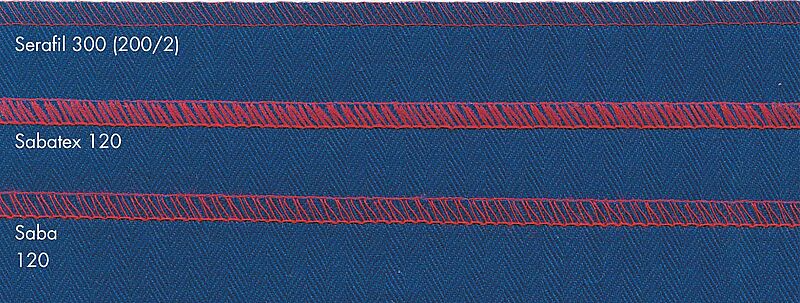
The appearance of the interior is determined by the sewing thread construction and size. Fine continuous filaments create an almost invisible, delicate seam finish, which is particularly desirable for fine fabrics. Textured multifilaments and microfilaments, on the other hand, cover the seam edge perfectly with their voluminous character. This is particularly useful for materials that fray easily. Core spun threads can be used for both closing and topstitching seams as well as for overedging, offering the advantage of universal applicability – keyword: single-thread concept.
Haptics
For sportswear and other skin-tight garments, the feel of the seams is the main factor in determining the sewing thread concept for overedging. Due to the individual nature of the material, there is no universal recommendation for ‘soft seams’. Only seam comparisons can determine the best solution here. All potential sewing thread concepts and sewing parameters should be tried out.
Behaviour during processing
Not all types of sewing thread are equally suitable for all overlock machines, and not all types of sewing thread are equally suitable as needle and looper thread. This has an impact on sewability and sewing safety. Texturised continuous filaments (also known as bulk yarns) are more open, less compact and have a lower thread closure due to their open construction. This can be disadvantageous for the stresses involved in the sewing process, especially for the needle thread. In practice, bulk yarns are therefore often used as looper threads in combination with core spun threads as needle threads.
Furthermore, the properties of the selected sewing threads have an influence on internal goods transport. Texturised continuous filaments, for example, tend to snag more easily (e.g. on rough surfaces) due to their open structure. These individual filaments pulled out of the thread are called pulled threads and should be taken into account when deciding on the sewing thread concept.
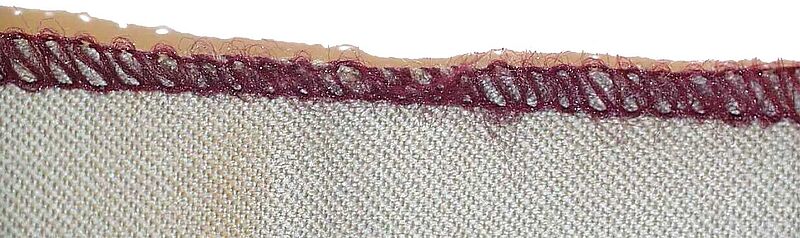
Furthermore, the overedging must not cause any difficulties during ironing. Delicate, fine fabrics often show iron marks as a result of overedging. The seam presence and thus the tendency to show iron marks depend on the type and size of the sewing thread, but also on the fabric and processing parameters. For critical fabrics, tests should be carried out before production begins in order to select the best sewing thread.
Laundry articles place special demands on functionality during processing. Here, the overedging must not be damaged by the (industrial) washing process, e.g. for leased articles. Core spun threads offer the best conditions for high mechanical stress during washing.
Function in use
The purpose of overedging is to protect the edges of the sewn fabric from fraying. If we follow the rule of thumb ‘the stronger the edge coverage, the higher the protection’, it becomes clear that not all types of sewing thread are equally suitable for this task. Bulky bulk yarns inevitably provide better coverage than delicate multifilament yarns or core spun threads. Depending on the fabric quality, i.e. depending on the tendency to fray, this criterion has varying significance. For fabrics that fray heavily, this argument alone can determine the choice. For fabrics that fray less, this criterion is irrelevant.
The aforementioned tendency of serging seams to leave iron marks is also important in later use.
Costs
The various sewing thread concepts for overedging differ not only in terms of feel, appearance and function, but also in price. Due to the simple production process, bulk yarns is naturally cheaper than twisted yarns. Due to their high thread requirements, serging seams often account for the majority of total thread consumption. The cost of serging threads therefore has a correspondingly large impact on the total sewing thread costs. However, sewing thread costs only account for a small proportion of the total cost of a garment. Switching to a higher-quality serging thread therefore usually only leads to a minimal increase in costs.
In addition to the pure procurement costs, production performance must also be taken into account for a correct cost estimate. Sewability and the number of corrective actions required (or the occurrence of second-choice parts) are important here and have a significant impact on productivity.
Limiting the colours of sewing thread for serging seams, for example to four basic colours, can save costs. Fewer colours mean less planning effort, lower stock levels, higher productivity due to less frequent colour changes on the sewing machine and, in some cases, lower purchasing costs due to larger order quantities. However, in this case, one must accept poorer colour matching of the serging to the fabric. For some manufacturers, this is unthinkable, while for others it is acceptable or even a desired design feature.
If you want to limit the number of colours, finishing with fine multifilament threads such as Serafil fine 300 offers particular advantages: the semi-transparency of this sewing thread size ensures the best possible colour match between the serging and the fabric. This is often aptly described as the chameleon effect. This effect makes it possible to minimise the colour selection in production facilities, especially for the serging seam. With a colour selection of four to five colours, most colourful materials can be processed.
The Serafil colour card contains several colours that are specifically designed to cover a wide colour spectrum.
| Colour no. | Colour | Colour of the outer fabric | |
|---|---|---|---|
| 1000 | Natural white |  | all white shades, light pastel, very bright colours, uni or patterned (e.g. bright beige, grey, green, blue) |
| 326 | Light beige |  | light through to medium colours, uni or patterned (e.g. light beige, grey, blue) |
| 329 | Dark beige |  | stronger, darker colours, uni or patterened (e.g. strong grey, brown, blue) |
| 4000 | Black |  | all dark colours |
Sewing thread concepts for overedging
The following table provides an overview of sewing thread concepts and a description of their properties.
| Construction and raw material of the sewing thread | AMANN article | Characteristics |
|---|---|---|
| Polyester / polyester core spun | Saba 150 Saba 120 Saba 100 Saba 80 |
|
| Polyester continious filament | Serafil fine 180 (120/2) Serafil fine 300 (200/2) Serafil fine 420 (300/2) |
|
| Polyester continious filament texturised | Sabatex 100 Sabatex 120 Sabatex 250 |
|
| Polyester microfilament texturised | Sabasoft 120 |
|
FAQ
-
The sewing thread influences seam appearance, durability, and processing behavior. It must be matched to both fabric and application.
-
Common thread types include continuous filaments, textured bulk yarns, and core spun threads. Each type offers different benefits in coverage and strength.
-
Bulk yarns provide high volume and excellent edge coverage. They are particularly suitable for fabrics that fray easily.
-
Core spun threads are ideal for applications requiring high strength and durability. They perform well under mechanical stress and repeated washing.
-
Fine threads create a subtle and smooth finish, while bulkier threads produce fuller coverage. The choice depends on the desired visual effect.
-
No, different threads behave differently during sewing. Bulk yarns are often used as looper threads, while stronger threads are preferred for needle threads.
-
Yes, certain threads and seam constructions can cause visible marks after ironing. Testing is recommended for sensitive fabrics.
-
Practical testing is essential to evaluate performance and appearance. Comparing different thread options helps identify the best solution.