
Intro
Selection of processing parameters plays a key role in achieving high-quality overedging results. Parameters such as stitch type, stitch density, thread balance, and seam width must be carefully adjusted to the material and application. Only a well-balanced setup ensures consistent seam appearance, reliable edge protection, and efficient production.
Stitch types
The following stitch types are suitable for classic overedging, i.e. securing the edges of the fabric against fraying:
2-thread overedging


3-thread overedging


In practice, the most commonly used stitch types are interlooped at the stitch hole (stitch types 502 and 504). Attaching the needle thread loop directly to the stitch hole has advantages in terms of correct thread balance and smooth processing of the fabric edge without curling. The most common is 3-thread overlocking (stitch type 504). Stitch formation with three threads offers the best conditions for a flawless stitch pattern, even with difficult fabric qualities. The 2-thread overlock is often used on the assumption that it requires significantly less sewing thread. However, the difference is not that great: stitch type 502 requires approx. 10% less sewing thread than stitch type 504 for the same stitch density and seam width.
In some cases, overedging is also carried out in a single operation with the production of the joining seam. For this purpose, 4-thread overlock seams, stitch types 512 and 514 (see illustrations below), or the classic safety seam (stitch types 401 and 504) can be used. In these cases, the durability and seam strength of the closing seam must be guaranteed. This usually means increasing the stitch density to at least four to six stitches per cm (depending on the application).
4-thread overedging


Thread balance
The correct thread balance of the needle and bobbin threads is important for a good appearance of the overedging. In practice, however, the serging seams often neither show interlooping at the needle hole nor on the edge, but something ‘in between’. This makes the seam appear uneven and untidy. Furthermore, this can lead to the seams showing through when ironing.

Stitch types
The stitch density determines the degree of cut edge coverage. In the clothing sector, a stitch density of 4 stitches/cm is standard. Fabrics that fray easily often require better coverage and therefore a higher stitch density. The same can apply to garments that undergo demanding industrial laundering after manufacture. In this case, practical tests must be carried out to determine the required edge protection. Fabrics that do not cause problems can also be serged with a lower stitch density.
Upholstery fabrics are often serged with a stitch density of 2.5–3 stitches/cm. For fine curtains, on the other hand, a stitch density of 4 stitches/cm is standard practice. Due to the wide variety of products and materials, there are no universal standards for technical textiles.
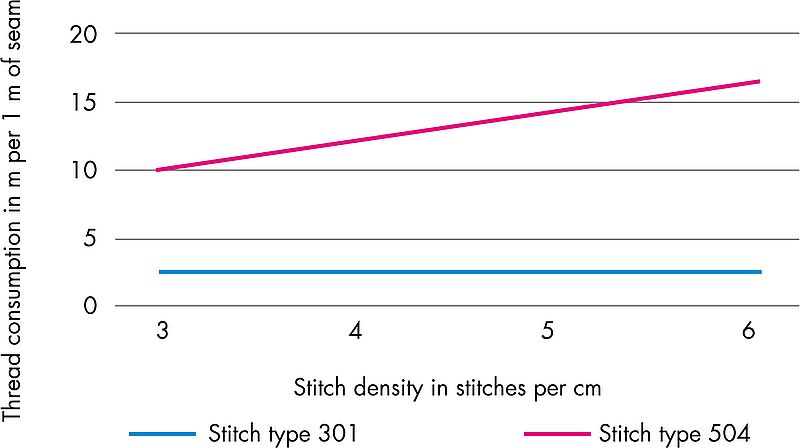
The stitch density influences thread consumption and thus also the sewing thread costs. A change in stitch density from 3 to 4 stitches/cm increases thread consumption by approx. 20%. Here, it is important to balance quality requirements (e.g. optimal coverage effect) with financial specifications.
The following diagram shows the influence of stitch density on thread consumption for the common overlock stitch type 504 compared to stitch type 301, which is used for closing seams.
Random samples of garments often show varying stitch densities at different seam positions. In addition to the unattractive appearance, this also makes it difficult to position the sewing thread precisely.
Seam width
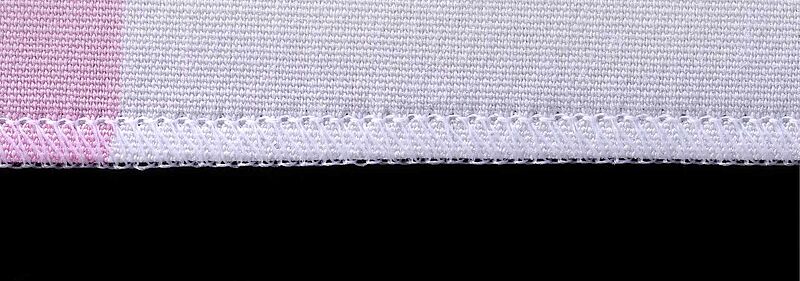
The seam width is determined by the machine design. 5 mm is the standard width. In accordance with the guiding principle ‘as wide as necessary, as narrow as possible’, this measurement has become established for almost all overlock machines. The seam must be wide enough to ensure secure edge coverage without the risk of tearing. On the other hand, the seam should be narrow enough to keep seam application and thread consumption to a minimum.
There are exceptions to every rule: with a rolled hem (using stitch type 504), the seam width is usually just under 2 mm.
Knives
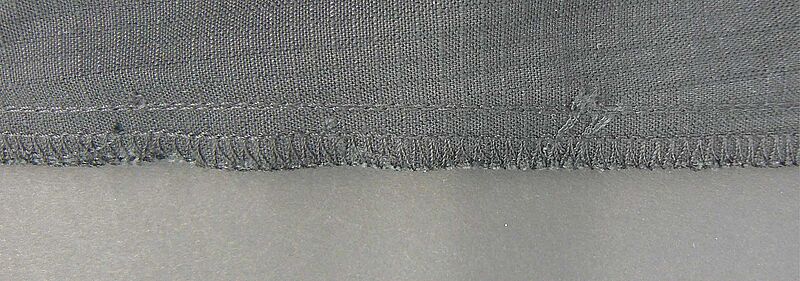
Very sturdy fabrics, but also materials that fray easily, rarely forgive a blunt knife on the overlock machine. The result is then extremely unattractive. For this reason, it is important to ensure that the knives are intact and sharp.
FAQ
-
Key parameters include stitch type, thread balance, stitch density, seam width, and machine condition. These factors directly affect seam appearance and performance.
-
Correct thread balance ensures a uniform and clean seam. Poor balance leads to uneven stitches and visible defects.
-
In apparel, around 4 stitches per cm is standard. Fabrics that fray easily may require higher stitch density for better edge coverage.
-
Higher stitch density increases thread consumption and costs. A balance between sufficient coverage and efficiency is essential.
-
A seam width of about 5 mm is standard for most applications. It ensures proper edge protection while keeping material usage efficient.
-
The seam must be wide enough to cover the edge securely but not excessively wide. Too wide seams increase thread usage and reduce efficiency.
-
Sharp knives ensure clean cutting of fabric edges before stitching. Blunt knives can cause uneven seams and poor visual results.
-
Yes, variations in stitch density or thread balance lead to uneven seams. This negatively impacts both appearance and functionality.