
Intro
Besides the linear density values that express the actual linear density of a thread, so-called ticket numbers are used for sewing and embroidery threads. These ticket numbers are shown both on the box and on the individual packages (cones, cops, king spools, etc.). They form an integral part of the product description and define the strength or linear density of the respective article.
The ticket numbers are based on
- the fixed-length system Nm of a 3-ply thread for synthetic sewing threads,
- the fixed-length system NeB of a 3-ply thread for cotton sewing threads,
- the fixed-length system NeB of a 2-ply thread for machine embroidery threads, and in exceptional cases, they are supplemented by an indication of the ply.
This explains why it is difficult to establish a uniform numbering system for defining the fine-grade specification in the sewing thread and embroidery thread sector. The current label numbers refer to the length-based numbering system. In technical circles, it is often mistakenly assumed that the ticket number is identical to the actual fine-grade specification according to the length-based numbering system (Nm). However, this assumption is incorrect.
The actual correlation between ticket numbers and the linear density of sewing threads has its historical origins in the introduction of a meaningful labelling system. At that time, almost all sewing threads were three-ply constructions, and the ticket number indicated the linear density of the yarn in Nm (for synthetic threads) or in NeB (for cotton threads).
Likewise, most embroidery threads were made from cotton and were, in addition, 2-ply constructions. Therefore, the ticket number also indicated the linear density of the single yarn in NeB.
The actual linear densities were rounded to values of 5 or 10 in order to simplify handling and achieve a uniform numbering system. As a result, the ticket number follows a fixed classification based on defined strength classes (e.g. No. 120, No. 100, No. 80, No. 75, No. 50).
Example:
- A synthetic sewing thread with a linear density of approximately Nm 120/3 is assigned ticket no. 120.
- A cotton sewing thread with a linear density of approximately NeB 40/3 is assigned ticket no. 40.
- An embroidery thread with a linear density of approximately NeB 40/2 is assigned ticket no. 40.
Sewing threads
As the development of sewing threads progressed, more and more 2-ply constructions entered the market, making it impossible to maintain the above labelling rule for sewing threads. This is clearly illustrated by a comparison of two sewing threads.
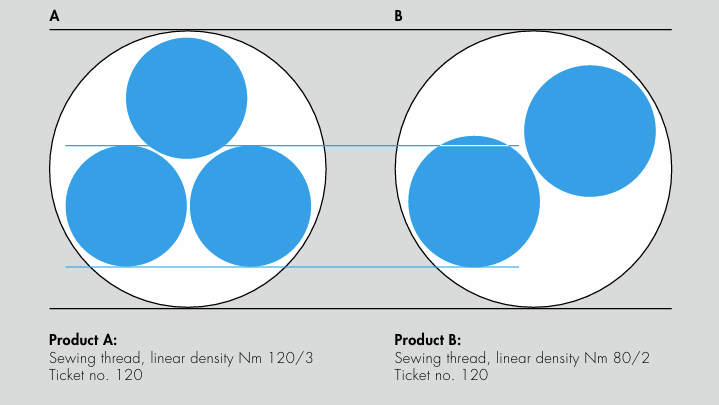
Calculation for example 1:
Product A:
Nm 120/3 = Nm 40 (final linear density);
40 (final linear density) × 3 (historically assumed ply number) = ticket no. 120
Product B:
Nm 80/2 = Nm 40 (final linear density);
40 (final linear density) × 3 (historically assumed ply number) = ticket no. 120
The ticket number is derived by dividing the linear density by the actual number of plies and then multiplying the result by the historical reference ply number (3). This yields the calculated ticket number (120). Both products have the same final linear density and are therefore comparable in terms of strength.
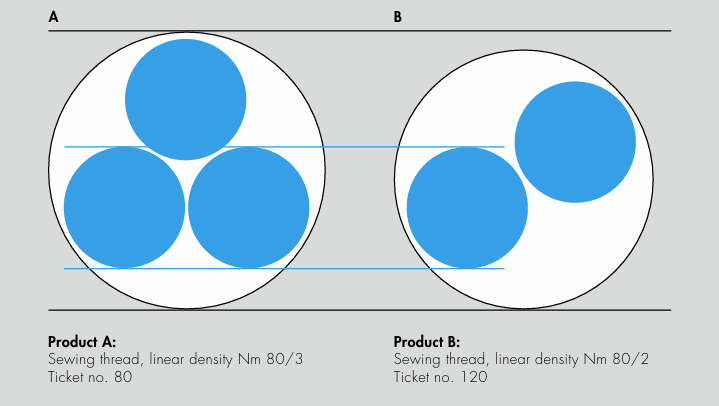
The products have different ticket numbers, despite having the same linear density of their yarns. The reason lies in the different number of plies.
Calculation for example 2:
Product A: Nm 80/3 = Nm 26.6 (final linear density) × 3 = ticket no. 80
Product B: Nm 80/2 = Nm 40 (final linear density) × 3 = ticket no. 120
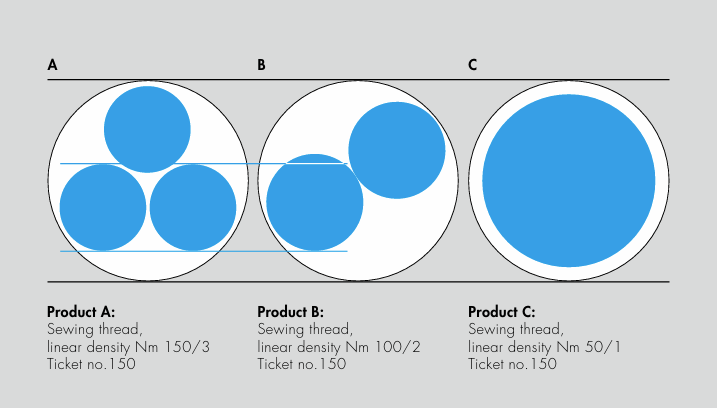
All three products consist of yarns with different linear densities; however, due to the differing thickness of the individual hanks, they have the same final linear density and therefore carry the same ticket number.
Calculation for example 3:
Product A: Nm 150/3 = Nm 50 (final linear density) × 3 = ticket no. 150
Product B: Nm 100/2 = Nm 50 (final linear density) × 3 = ticket no. 150
Product C: Nm 50/1 = Nm 50 (final linear density) × 3 = ticket no. 150
There is no standard or mandatory regulation for the indication of ticket numbers for sewing threads. The labelling system described above is the one commonly used in Europe. In other countries—particularly in Asia—different labelling systems are used. It is essential to know the actual linear density (in Tex or Nm) in order to evaluate thread counts and select the appropriate thread.
Embroidery threads
Regardless of the raw material, embroidery threads are numbered in accordance with the English cotton fixed-length system NeB. The reason for this lies in their history: mercerised cotton threads were already in use when the first embroidery machines were invented at the end of the 19th century, and they were labelled according to the NeB system. At that time, high-gloss synthetic threads did not yet exist, and silk was too expensive and used only for hand embroidery. As a result, mercerised cotton was the material used for producing glossy threads.
With the emergence of the first synthetic embroidery threads in the mid-20th century, it seemed natural to align the linear density with the cotton system once again. This was mainly because an embroidery design punched card for a 40 yarn could continue to be used with a 40 yarn. A conversion to a different, technically more accurate system was already rejected at that time.
In contrast to sewing threads, however, a 2-ply construction was chosen as the basis for labelling. This is understandable, as almost all embroidery threads are 2-ply constructions. The ticket number for embroidery threads therefore indicates the linear density of the single yarn in NeB.
Example:
An embroidery thread with the linear density ~ NeB 40/2 has the ticket no. 40.
An embroidery thread with the linear density ~ NeB 30/2 has the ticket no. 30.
In contrast to the sewing thread range, the entire embroidery thread range—including polyester, cotton, wool, and metallic qualities - covers only five to six strengths, ranging from 12 to 75.
The most important ticket number is 40, which accounts for an estimated share of more than 80% worldwide.
Because it is often difficult to correctly assign the ticket numbers of embroidery and sewing threads, the following table brings together the most important embroidery thread ticket numbers and the corresponding sewing thread ticket numbers. This comparison is useful when sewing threads are used instead of embroidery threads for embroidery applications.
| Embroidery ticket no. | Cotton ticket no. | Linear density | Corresponsing sewing thread ticket no. |
|---|---|---|---|
| No. 12 | No. 18 | Nm 20/2 | No. 30/35 |
| No. 25/30 | No. 35/45 | Nm 50/2 | No. 75/80 |
| No. 40 | No. 60 | Nm 70/2 | No. 120 |
| No. 50 | No. 75 | Nm 85/2 | No. 140/150 |
| No. 60 | No. 90 | Nm 120/2 | No. 180 |
| No. 75 | No. 112 | Nm 130/2 | No. 220/2/300 |
FAQ
-
Ticket numbers are practical labels indicating thread thickness. They are commonly printed on packaging.
-
No, ticket numbers are simplified classifications. They do not directly represent actual linear density.
-
They are historically based on length-based systems like Nm or NeB. They are rounded into standard classes.
-
They are easy to understand and widely accepted in the industry. Many technicians prefer them.
-
Yes, different constructions can result in the same final thickness. This makes direct comparison tricky.
-
They do not follow a strict international standard. Their meaning depends on thread type and construction.
-
Yes, they are based on different ply assumptions. Sewing threads typically use 3-ply references, embroidery threads 2-ply.
-
Actual linear density values like Tex or Nm. These provide precise technical information.